
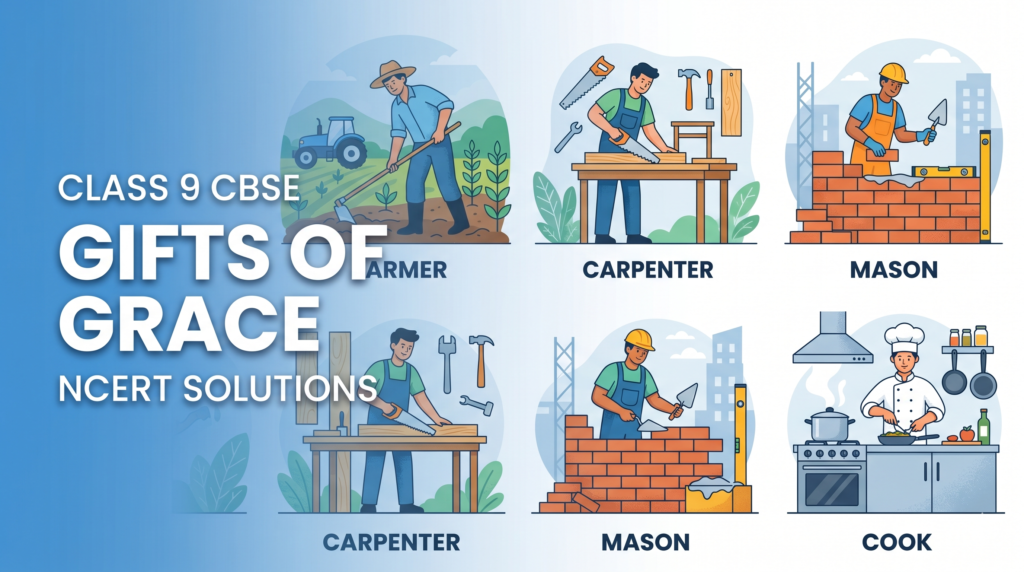
If you are preparing for Class 9 CBSE English, this chapter is important for understanding themes like dignity of labour, identity, and contribution to society. Gifts of Grace: Honouring Our Vocations highlights how different professions shape daily life and deserve respect.
Students often struggle to write clear and structured answers in exams. This page provides complete NCERT solutions so you can understand how to frame answers properly and improve accuracy.
All sections are covered, including Reflect and Respond, Check Your Understanding, Critical Reflection, Vocabulary in Context, and Writing Task.
Reflect and Respond
I Given below are four riddles. Read and identify who these people are.
- In furrows deep, secrets I sow,
As time passes,
I watch them grow.
Who am I?
Answer: Farmer - From wheel to kiln, my skill is born,
Step by step, an art takes form.
Who am I?
Answer: Potter - I lay foundations, brick by brick,
To build a house, it’s me you pick.
Who am I?
Answer: Mason - I work with pots, pans, and spice,
Creating dishes that taste so nice.
Who am I?
Answer: Cook / Chef
II What is the role and relevance of the people you identified in the riddles. How do they contribute to the society?
Answer: Farmers grow food and support life. Potters make useful clay items such as pots and vessels. Masons build houses and other structures. Cooks prepare food and nourish people. All of them contribute to society through skill, labour, and service.
Check Your Understanding
I Based on your understanding of the poem, state whether the following statements are true or false. Also, rectify the false statements.
- The poem highlights the skilled work of craftsperson.
Answer: True - The poet shares that musicians express emotions through their instruments.
Answer: True - The carpenters in the poem are admired for their logical work.
Answer: False
Correct answer: The carpenters are admired for creating things out of wood with mathematical precision. - The electricians in the poem are recognised for their crucial role in lighting up lives.
Answer: True - The poem pays homage to shoemakers who manufacture quality footwear.
Answer: True - The poem celebrates the patriotism of the people of Bharat.
Answer: False
Correct answer: The poem celebrates the varied vocations and the dignity of labour in Bharat. - The poet feels that each vocation deserves to be respected.
Answer: True
II Let us appreciate the poem.
- Rhyme Scheme and Lineation
(i) Does the poem strictly adhere to a rhyme scheme, or is it in free verse?
Answer: The poem is written in free verse and does not follow a strict rhyme scheme.
(ii) What is the impact of the varying length of lines in the poem?
Answer: The varying line lengths create a natural flow, give emphasis to different vocations, and make the poem sound conversational and lively.
(iii) What is the pattern in the structure of most lines of the poem?
Answer: Most lines begin with “The” followed by the name or description of a vocation and an action associated with it. - Speaker
(i) Who appears to be the speaker and what is her/his role here?
Answer: The speaker appears to be an observant and appreciative voice who listens to and celebrates the workers of Bharat. The speaker’s role is to honour their skills and contributions. - Tone and Mood
(i) Fill in the blanks with suitable options from the box given below.
A. The tone is __ and _, depicting a sense of admiration and respect for the artisans and craftspersons.
Answer: celebratory and reverential
B. There is a _ mood throughout the poem, capturing the vibrancy and richness of cultural traditions and skills.
Answer: joyful - Imagery
(i) Select any two descriptions from the poem that evoke visual images.
Answer:
“woven with colours and myriad hues”
“The boatmen gathering their nets from the shore”
(ii) Fill in the blanks with suitable phrases.
The poem includes auditory imagery through mentions of artisans with lutes, ___, and ___, emphasising the sounds associated with each vocation.
Answer: electricians humming and the delicious singing of the cook - Metaphor
(i) State whether the following sentence is true or false.
The mention of ‘delicious singing’ of the cook is a metaphor because it implies that the quality of the singing is so enjoyable or pleasing that it can be equated to the experience of tasting something delicious.
Answer: True - Personification
(i) Select the line that tells us that the poet personifies vocations by attributing humanlike qualities to them.
Answer: “The voice of their vocation is the voice of their identity.” - Repetition
(i) Why might the poet have begun and ended with the same line—‘I hear Bharat celebrating, the varied vocations I hear!’?
Answer: The repetition emphasises the central idea of the poem, creates a sense of unity, and reinforces the celebration of all vocations. - Alliteration
(i) Identify two examples of alliteration from the poem.
Answer:
“work with cables and wires”
“sailing, and singing while at work” - Symbolism
(i) Each vocation in the poem symbolises something more than just a job. What does it symbolise?
Answer: Each vocation symbolises identity, dignity of labour, skill, and service to society.
Critical Reflection
I Read the extract given below and answer the questions that follow.
The shoemakers affirming the quality of their work, for the feet that walk, dance, run, jump, return home.
The delicious singing of the cook, or the rhythm of designer, mason, each celebrating what belongs to them and to none else,
- The poet says that the shoemakers ‘affirm’ the quality of their work. What does ‘affirm’ refer to here?
(i) to make adjustments in
(ii) to declare with confidence
(iii) to label the goods
(iv) to justify the efforts
Answer: (ii) to declare with confidence - What do quality shoes help with, according to the poet?
Answer: Quality shoes help the feet to walk, dance, run, jump, and return home. - What does ‘return home’ symbolise besides the literal act of returning?
Answer: It symbolises safety, rest, comfort, and the completion of one’s daily journey. - Identify the phrase that tells us that every worker’s contribution is distinct.
Answer: “each celebrating what belongs to them and to none else” - Complete the following with suitable words.
…for the feet that walk, dance, run, jump, return home refers to _.
Answer: the different movements and activities of everyday human life
II Answer the following questions.
- Why does the poet say, ‘I hear Bharat celebrating, the varied vocations I hear’?
Answer: The poet says this because Bharat is presented as a land where different workers perform their tasks with pride, skill, and dedication, making the whole nation seem alive with celebration. - What does the electrician ‘humming’ while getting ready for work suggest?
Answer: It suggests that the electrician works with energy, cheerfulness, and dedication. - Explain the significance of the line, ‘The voice of their vocation is the voice of their identity.’
Answer: The line means that a person’s vocation expresses who they are. Their work reflects their skills, individuality, and contribution to society. - Do you think the role of all the people belonging to different vocations is important in our daily lives? Support your answer with a reason.
Answer: Yes, all these roles are important because each vocation fulfils a necessary function in society. For example, farmers provide food, carpenters make useful objects, electricians light homes, and cooks prepare meals. - Why is the poet celebrating all the vocations in the poem? Explain by giving examples from your context.
Answer: The poet celebrates all vocations because all honest work has dignity and value. In my context too, teachers educate us, drivers help us travel, farmers provide food, and sanitation workers keep our surroundings clean. - How does the poet use sensory imagery to bring out the beauty of everyday work?
Answer: The poet uses visual imagery such as “colours and myriad hues”, auditory imagery such as “lutes”, “humming”, and “singing”, and movement imagery such as “walk, dance, run, jump” to make everyday work vivid and beautiful.
Vocabulary in Context
I People of different vocations are being described in the poem. Match the vocations given in the box below with the descriptions that follow.
- A person who studies or grows garden plants:
Answer: horticulturist - A trained female community health worker:
Answer: ASHA worker - A producer of raw silk:
Answer: sericulturist - A person whose job is making or selling sweets and chocolates:
Answer: confectioner - A metalworker who specialises in working with precious metals:
Answer: goldsmith - A person who fuses materials together:
Answer: welder
II Identify the word from Column 2 that is not the synonym of the words given in Column 1.
- myriad
Answer: countable - hues
Answer: drawing - precision
Answer: calculation - varied
Answer: uniform - delicious
Answer: inedible
Listen and Respond
I You will listen to two friends, a boy and a girl discussing the occupations of their parents. As you listen, answer the following question in two to three words only.
What does the boy use to understand the details of the tools?
Answer: toy cars
II You will listen to the girl and the boy once again. As you listen, answer the questions by selecting the correct option.
- The girl is __ about taking food for her mother at the factory.
(i) happy
(ii) boastful
(iii) unsure
Answer: (i) happy - The boy thinks that the job of the girl’s mother carries a lot of __.
(i) luck
(ii) risk
(iii) responsibility
Answer: (iii) responsibility - The girl __ why the boy is good at science exhibitions.
(i) wonders
(ii) questions
(iii) realises
Answer: (iii) realises - The girl shares her __ about joining the weekend discussion on tools.
(i) doubts
(ii) wish
(iii) ideas
Answer: (ii) wish
Writing Task
I Your school will be organising a ‘Career Mela’ in which students are to be made familiar with the different career options. Complete the poster for the event given below.
Answer:
NAME OF THE ORGANISER
ABC Public School
purpose (if any)
Career Guidance Cell
announces
CAREER MELA
to spread awareness about various careers
Date
on 25 February from 9 a.m. to 6 p.m.
at ABC Public School, New Delhi
Highlights:
Details, information and guidance provided for all streams
Counsellors for all career options
Interactive sessions with professionals
Slogan
CHART YOUR FUTURE AT CAREER MELA
Entry tickets: FREE
Issuing Authority
Principal
ABC Public School
Learning Beyond the Text
II Visit the website https://www.msde.gov.in/
Collect information on any one vocation of your choice. Prepare a presentation explaining the following.
Reason for your choice
How is it helpful to the society and self?
Answer: Sample presentation on the vocation of a carpenter
Reason for my choice:
I chose carpentry because it is a skill-based vocation that combines creativity, precision, and utility.
How is it helpful to society?
Carpenters make furniture, doors, windows, shelves, and many other useful objects needed in homes, schools, and offices.
How is it helpful to self?
This vocation develops patience, practical skills, accuracy, and self-reliance. It can also provide livelihood and opportunities for self-employment.
III Now, create a Haiku poem and share with your classmates and teacher.
Answer:
Hands shape silent wood
Songs rise from honest labour
Life glows through their work
How to Use These NCERT Solutions
Read the poem first and try to understand the main idea. Then attempt the questions on your own.
After that, check the answers and focus on how they are written. Pay attention to keywords, structure, and clarity.
Revise important concepts like imagery, tone, symbolism, and literary devices because these are often asked in exams.
Why This Chapter is Important
This chapter focuses on dignity of labour and the value of every profession in society.
It helps you understand how literature reflects real life and teaches respect for different roles.
Questions from this chapter often test your understanding of themes, tone, and interpretation.
Who Should Use This
This content is useful for:
- Class 9 CBSE students
- Students preparing for school exams
- Learners who want clear NCERT answers
- Students improving answer writing
Bharat Our Land Class 9 NCERT Solutions