
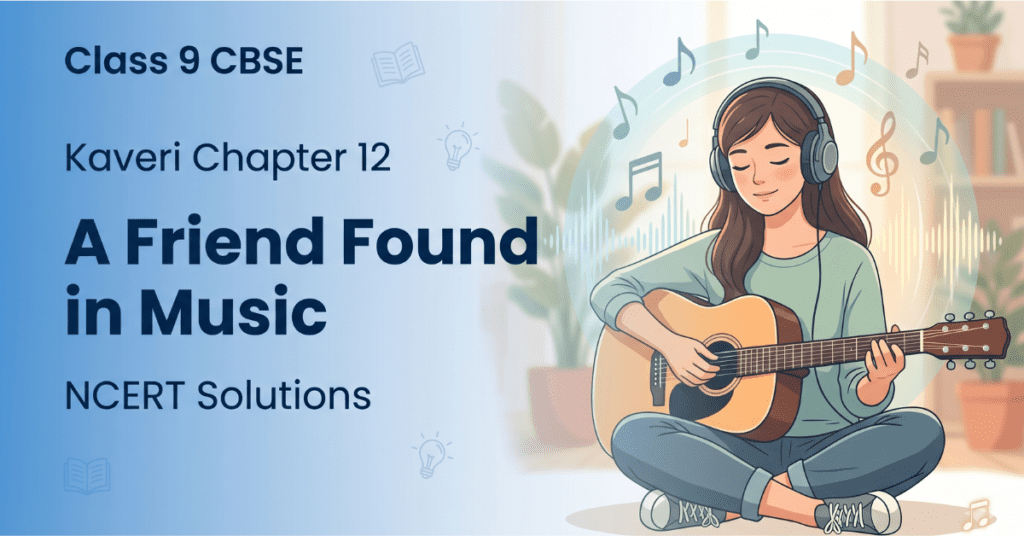
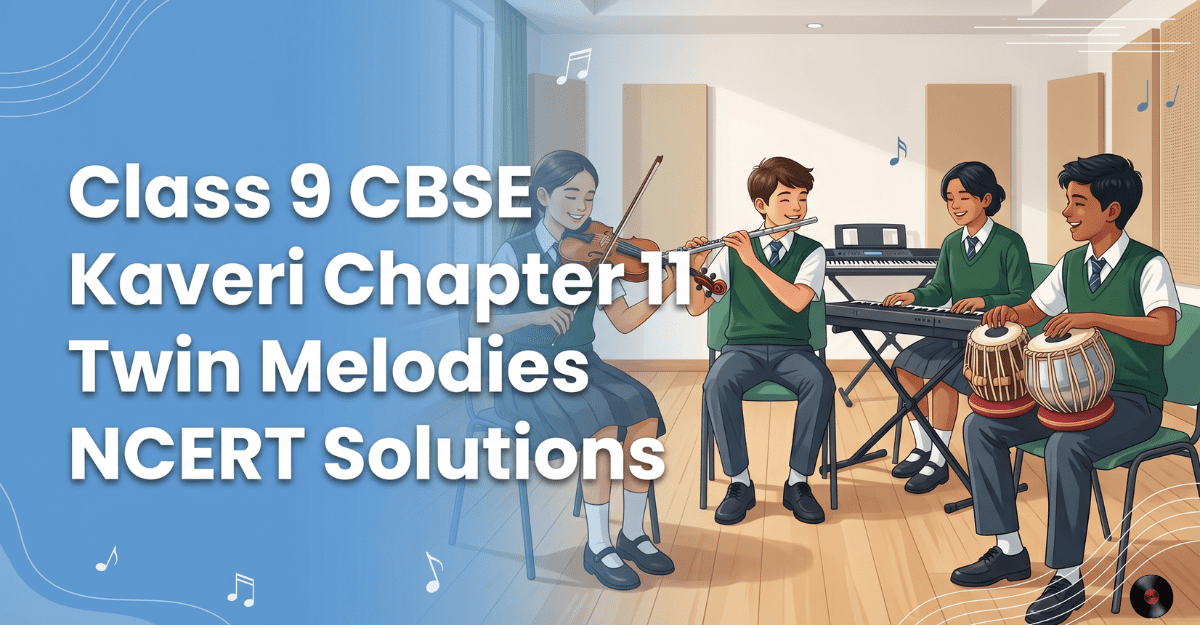
If you are preparing for Class 9 CBSE English, this chapter is important for understanding the emotional power of music. A Friend Found in Music shows how music acts as a source of comfort, strength, and companionship.
Students often find poetry interpretation and vocabulary questions difficult. This page provides complete NCERT solutions to help you understand answers clearly and improve your writing in exams.
All sections are covered, including Reflect and Respond, Check Your Understanding, Critical Reflection, Vocabulary in Context, Listen and Respond, Speaking Activity, Writing Task, and Learning Beyond the Text.
Reflect and Respond
I Read the questions given below and share your answers with your classmates and teacher.
- What kind of music do you prefer to listen to—vocal or instrumental?
Answer:
I prefer to listen to instrumental music because it is soothing and helps me relax. - Name your favourite musician(s).
Answer:
My favourite musicians are A.R. Rahman and Pandit Ravi Shankar. - Give reasons for your choice.
Answer:
I like their music because it is soulful, melodious, and emotionally powerful. Their compositions create a deep impact on the listener.
Check Your Understanding
I Read the poem again to complete the poet’s diary about her feelings on music. Fill in the blanks with words from the poem.
Today, I’ve been thinking about how essential music is to me. It is like an ocean that calls me to its 1. shore. Music is the 2. rhythm that harmonises with my 3. core, moving me in ways I can’t explain. When I feel sad or upset about things, music is the 4. therapy that eases the ache. It is amazing how music has the power to lift my 5. spirits, and give me strength to pull through difficult times. I know that it is the effect of music whenever I feel 6. blue. Music is the much 7. needed, dependable friend when there is no one to 8. care. Thank you, my dear music, for being my all-time comfort.
II Let us appreciate the poem.
- The phrase ‘moves me’ in the line ‘That moves me to the core,’ is an example of _.
Answer:
personification - The poet uses metaphors for music. List these metaphors and rewrite them as similes. For example, Music is as as ___.
Answer:
Metaphors:
Music is the ocean.
Music is the rhythm.
Music is the therapy.
Music is the needed friend.
Similes:
Music is as vast and powerful as the ocean.
Music is as stirring as rhythm.
Music is as healing as therapy.
Music is as dependable as a needed friend. - What is the rhyme scheme of the poem? What impact does it have?
Answer:
The rhyme scheme of the poem is A A B B C C. It gives the poem a musical, smooth, and pleasant flow. - What is the poet’s purpose in using the word ‘music’ repetitively?
Answer:
The poet uses the word ‘music’ repetitively to emphasise its importance in her life and to keep the focus on the central idea of the poem. - What is the message the poet wishes to convey through the poem?
Answer:
The poet wishes to convey that music is a source of comfort, healing, strength, and companionship. - Identify the mood of the poem from the options given below.
(i) nostalgic
(ii) thoughtful
(iii) amused
(iv) playful
Answer:
(ii) thoughtful - Give evidence from the poem to support that the speaker is the poet herself.
Answer:
The poem uses first person expressions such as “pulls me”, “moves me”, “I need”, “I feel blue”, and “I’m most cheerful”, which show that the speaker is expressing her own feelings.
Critical Reflection
I Read the extract given below and answer the questions that follow.
- Music is the therapy
I need when I feel blue.
Music lifts my spirits
To make sure I pull through.
(i) Complete the following sentence suitably.
The phrase ‘feel blue’ indicates _.
Answer:
sadness
(ii) Identify the line which shows music makes the poet happy.
Answer:
“Music lifts my spirits”
(iii) What does the last line of the extract signify?
Answer:
The last line signifies that music gives the poet strength to overcome difficult times.
(iv) State whether the following sentence is true or false.
Music plays a vital role in the poet’s life.
Answer:
True
(v) Select the central idea of the extract from the following options.
A. Music brings comfort during sadness.
B. Music is a necessity in times of happiness.
C. Music improves our ability to pull heavy loads.
D. Music is a source of knowledge and excitement.
Answer:
A. Music brings comfort during sadness.
II Answer the following questions. - How is music able to move the poet ‘to the core’?
Answer:
Music affects the poet deeply by touching her emotions and giving her comfort and strength. - Why does the poet compare music to a ‘needed friend’?
Answer:
The poet compares music to a needed friend because it supports, comforts, and stays with her when she feels lonely or sad. - Explain the poet’s attitude towards music.
Answer:
The poet’s attitude towards music is loving, grateful, and deeply appreciative. She sees music as essential in her life. - Support the opinion that this poem has a universal appeal.
Answer:
This poem has a universal appeal because people everywhere experience joy, sadness, loneliness, and comfort through music. The feelings expressed in the poem are common to all human beings. - Compare your experience of music with the feelings expressed in the poem.
Answer:
My experience of music is similar to the poet’s feelings. Music helps me relax, improves my mood, and gives me comfort whenever I feel stressed or unhappy.
Vocabulary in Context
I Read the following phrases from the poem denoting happiness and sadness.
Classify the words given in the box below as positive emotions and negative emotions.
feel blue lifts my spirits most cheerful
V Positive emotions (happiness): _________
Answer:
lifts my spirits, most cheerful
V Negative emotions (sadness): _________
Answer:
feel blue
Now, fill in the blanks by choosing the correct word from those given in the brackets.
- The familiar tune stimulated a rush of _, transporting listeners back to cherished moments from their past. (nostalgia/elation)
Answer:
nostalgia - The soulful ballad expressed the singer’s _, leaving the audience moved by the intensity of their emotions. (despondence/anguish)
Answer:
anguish - The pianist played a soulful melody on the stage, creating an ambience of __. (melancholy/despair)
Answer:
melancholy - The festive symphony filled the air with _ tones, lifting the spirits of everyone present on the joyous occasion. (jubilant/euphoric)
Answer:
jubilant
II Read the highlighted word in the line given below.
To make sure I pull through
Answer:
“pull through” means to succeed in doing something very difficult. It is a phrasal verb.
III Choose the correct meaning from the box given below for the underlined phrasal verbs in the following sentences. - He’s planning to move out of his parents’ house next month.
Answer:
(v) to leave a place where one has been living - Our new neighbours moved in yesterday.
Answer:
(ii) to begin living in a new home or place - I’ve been in this job long enough—it’s time I moved on.
Answer:
(i) to start doing or discussing something new - Can you move over a bit so I can sit down?
Answer:
(vi) to shift position to make space for someone or something - The police officer told the crowd to move along.
Answer:
(iv) to go to a new position, especially in order to make room for other people - The bus moved off as soon as all the passengers were seated.
Answer:
(iii) to start moving; to leave
IV Create phrasal verbs from the verbs ‘put’, ‘get’, ‘look’, ‘break’. Find the meanings of the phrasal verbs you create. Make sentences with the phrasal verbs. Discuss them with your classmates and teacher.
Answer: - put off — postpone
Sentence: We had to put off the match because of rain. - get over — recover from
Sentence: She worked hard to get over her fear of speaking on stage. - look after — take care of
Sentence: I look after my younger brother after school. - break down — stop functioning
Sentence: Our school bus broke down on the way.
Listen and Respond
I Before you listen, read the questions and guess the responses to the given questions.
- How are the two speakers connected?
(i) parent-child (ii) teacher-student
(iii) brother-sister
Answer:
(i) parent-child - Where is the conversation taking place?
(i) music centre (ii) park
(iii) school reception area
Answer:
(i) music centre - Which musical instrument is the reason for the problem?
(i) sitar (ii) santoor (iii) sarod
Answer:
(ii) santoor - What is the problem being discussed?
(i) inability to play the musical instrument
(ii) irregularity of the music class
(iii) lack of choice of the musical instrument
Answer:
(ii) irregularity of the music class - What has been the unsuccessful solution?
(i) practising for longer hours
(ii) singing while playing the instrument
(iii) watching videos about playing the instrument
Answer:
(iii) watching videos about playing the instrument - What is the final decision taken?
(i) change classes
(ii) pick a simpler instrument
(iii) purchase the musical instrument
Answer:
(iii) purchase the musical instrument
II Now, listen to the conversation between the two people. As you listen, check your answers and rectify them wherever needed. Once done, discuss your responses with your classmates and teacher. (Transcript for teacher on page 270)
Answer:
The checked answers are:
parent-child
music centre
santoor
irregularity of the music class
watching videos about playing the instrument
purchase the musical instrument
Speaking Activity
I Work in groups of four and choose a role each. Use the cues given below to present a role play in the class. Frame your responses logically in complete sentences. You may frame appropriate questions to ensure continuity in the conversation.
Music teacher: encourages the student to take up music classes
Student 1: confused – feels music class may take away time from studies
Student 2: music learner – is convinced that music is beneficial and can manage time
Parent: initially doubtful but later supportive after the discussion
Answer:
Music teacher: Music classes can help students develop concentration, discipline, and creativity. They support studies rather than disturb them.
Student 1: I like music, but I am worried that music classes may take away time from my studies.
Student 2: I learn music and I still manage my studies well. Music actually helps me relax and stay focused.
Parent: I was doubtful at first, but now I understand that music can be beneficial if time is managed properly.
Music teacher: That is true. With a proper routine, students can enjoy music and also do well in academics.
Student 1: I think I should try joining the class and learn how to balance both.
Parent: Yes, you should. We will support you.
Writing Task
I Your school is organising a musical evening on 21 June, World Music Day. You are presenting a Sitar recital at the event. Draft an invitation letter requesting your grandparents to attend the event.
Answer:
23, Green Park
Lucknow
10 June 2026
Dear Grandmother and Grandfather,
I hope both of you are in good health and cheerful spirits. We are all fine here and often think of you with love.
I am very happy to share that my school is organising a musical evening on 21 June to celebrate World Music Day. I will be presenting a Sitar recital at the event. The programme will begin at 5:00 p.m. in the school auditorium.
I would be very happy if you could come and bless me with your presence. Your encouragement always gives me confidence, and this occasion will become even more special if both of you attend.
Please do come. I am eagerly waiting to see you there.
Yours affectionately,
Ananya
Learning Beyond the Text
I Did you know, India’s rich musical heritage has a lot to offer to our well-being? Raga Chikitsa, one of the ancient texts, elaborates on the healing properties of music. A seventeenth century work titled Sangita Sudha gives an account of the effects of music on emotions. Find out how music is used as an alternative therapy in the present times.
Answer:
In the present times, music is used as an alternative therapy to reduce stress, anxiety, and depression. It is also used in hospitals, counselling centres, special education, rehabilitation, and meditation practices to improve emotional and mental well-being.
II Everything in nature has a rhythm or sound vibration, even our heartbeat. Speak to your music teacher and find out about the origin of the seven swaras (notes) of Indian classical music.
Answer:
The seven swaras of Indian classical music are Sa, Re, Ga, Ma, Pa, Dha, and Ni. They are traditionally believed to have originated from natural sounds and vibrations and are linked with the sounds of animals and birds in ancient musical thought.
III You must have read or heard poems and songs about music—both in English and in your own language. Share some of them with your classmates and create a collection of these poems and songs together.
Answer:
Examples:
“Music” by Walter de la Mare
“Where Words Fail, Music Speaks”
“Vande Mataram”
“Sa Re Ga Ma” songs
regional folk songs and bhajans about music
IV Read and enjoy the poem given below.
Answer:
Activity-based. Read and enjoy the poem.
How to Use These NCERT Solutions
Read the poem carefully and focus on the feelings expressed by the poet.
Try answering the questions on your own before checking the answers. This will improve your interpretation and writing.
Pay attention to poetic devices like metaphor, personification, and imagery because they are frequently asked in exams.
Why This Chapter is Important
This chapter highlights how music can provide comfort, healing, and emotional support.
It shows that music can act like a friend in times of loneliness and sadness.
Questions from this chapter often test interpretation, mood, tone, and vocabulary.
Who Should Use This
This content is useful for:
- Class 9 CBSE students
- Students preparing for English exams
- Learners struggling with poetry
- Students are improving answer writing