
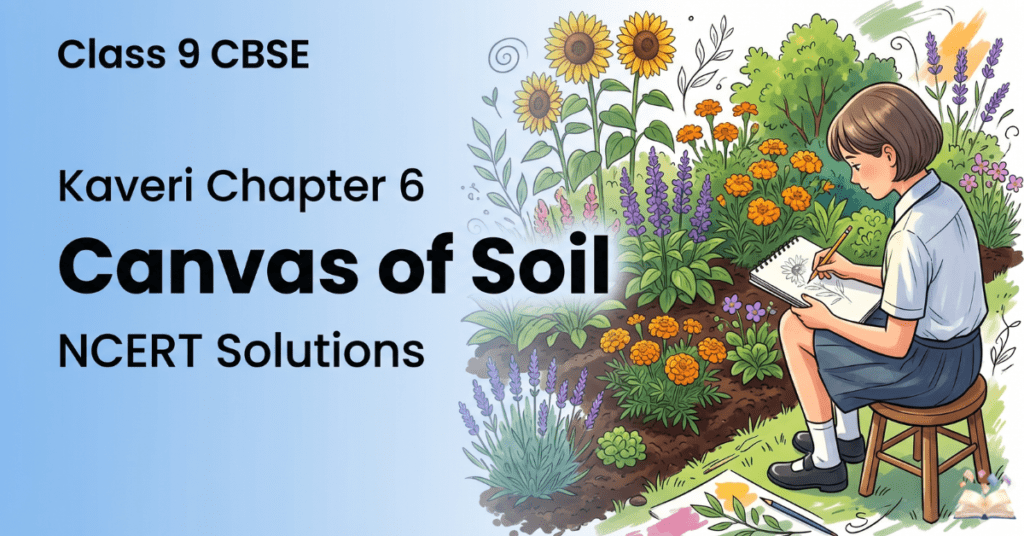







If you are preparing for Class 9 CBSE English, this chapter is important for understanding poetic devices and imagery. Canvas of Soil presents gardening as an art where nature and creativity come together.
Students often find poetry difficult because of metaphors and symbolism. This page provides complete NCERT solutions to help you understand answers clearly and improve your writing in exams.
All sections are covered, including Reflect and Respond, Check Your Understanding, Critical Reflection, Vocabulary in Context, and Writing Task.
Reflect and Respond
I Work in pairs. Discuss what all you see in a garden. Think of the colours you see and where you see them. Share your responses with your teacher.
Answer: Sample answer: In a garden, we can see flowers, leaves, buds, grass, trees, butterflies, pathways, and sometimes pots or benches. We usually see red, pink, yellow, white, and purple in flowers; different shades of green in leaves and grass; brown in soil and tree trunks; and blue in the sky above the garden.
II Look at the picture of a garden and a painting given below. Speak about any similarities between the garden and the painting.
Answer: Sample answer:
Just as a garden has many colours and patterns, similarly, a painting also has many colours and patterns.
A garden and a painting, both look beautiful and creative.
Colour and design are common to both a garden and a painting.
Like a garden, a painting too can express beauty and imagination.
III Let us acquaint ourselves with the meanings of palette, hue, and canvas.
Palette: a thin oval or rectangular board or tablet that a painter holds and mixes colours on.
Hue: shade of a colour
Canvas: (here) painting
Now, look at the painting given above and identify palette, canvas, and select a hue.
Answer:
Palette — the board on which a painter mixes colours
Canvas — the surface/picture on which the painting is made
Hue — green (sample selected hue; any visible shade could be chosen)
Check Your Understanding
I Read the poem again and complete the summary of each stanza by filling in the blanks.
Answer:
The earth is portrayed as a rich palette where gardeners’ dreams flourish in the form of seeds, awaiting spring.
The garden flowers bloom into a beautiful display of different blossoms, resembling a painting by Mother Nature, in the light of morning.
Each garden is likened to a wide canvas, integrating art and life. Through the efforts of gardeners, gardens transform into still-life paintings.
II Select the appropriate title for each stanza from those given below. There are two extra titles.
Nature’s Work of Art
Sweet-smelling Blossoms
Gardens as Living Canvases
Earth and Possibilities
The Painter’s Canvas
Answer:
Stanza 1 — Earth and Possibilities
Stanza 2 — Nature’s Work of Art
Stanza 3 — Gardens as Living Canvases
III Match the poetic devices in Column 1 to the examples in Column 2.
Answer:
Imagery — (iv) colours, brushstrokes, blossoms, shades of green
Metaphor — (vi) garden as a painting, plot as canvas, seeds as brushstrokes
Rhyme Scheme — (ii) AABB
Tone — (i) appreciative
Mood — inspired / delighted (the exact matching option is not fully visible in the retrieved extract, but this is the correct interpretive answer)
Speaker — (v) a gardener
Allegory — the garden symbolising life’s journey, growth, harmony, and diversity
Critical Reflection
I Read the given extracts from the poem and answer the questions that follow.
- Brushstrokes of seeds, planted true, / Awaiting spring’s vibrant hue.
(i) The poet has used a metaphor in ‘Brushstrokes of seeds’. Which option from those given below uses a metaphor?
A. Her mother’s heart heard her heartfelt request with kindness.
B. She has a heart of gold.
C. Her heart did a dance of joy on seeing the new doll.
D. She has a very kind heart.
Answer: B. She has a heart of gold.
(ii) Complete the sentence appropriately. The phrase ‘planted true’ is significant because it implies _.
Answer: it implies careful, sincere, and purposeful planting.
(iii) Why has the poet used the word ‘hue’ instead of ‘colours’ in the extract?
Answer: The word ‘hue’ is more poetic and suggests a particular vivid shade, which makes the image more artistic and musical. It also fits the poetic expression better.
(iv) Complete the following analogy correctly with a word from the extract. Summer: hot :: Spring :
Answer: vibrant
(v) Read the Assertion (A) and the Reason (R) and select the option that is correctly suited.
(A): Gardeners wait for Spring.
(R): Gardens are worth painting in Spring.
A. Both (A) and (R) are true and (R) is the correct explanation of (A).
B. Both (A) and (R) are true but (R) is not the correct explanation of (A).
C. (A) is true but (R) is false.
D. (A) is false but (R) is true.
Answer: B. Both (A) and (R) are true but (R) is not the correct explanation of (A). - Each plot, a canvas wide, / Where art and life coincide.
(i) What does ‘Each plot’ refer to in this extract?
Answer: Each plot refers to each piece/section of garden land.
(ii) Select which option imitates the rhyme scheme of the extract.
A. beautiful and clear / laughter and cheer
B. beautiful and clear / laughter and tears
Answer: A. beautiful and clear / laughter and cheer
(iii) Select the line from the extract that conveys that gardening blends aesthetic beauty with natural growth.
Answer: “Where art and life coincide.”
(iv) Complete the following sentence appropriately. The plot is likened to a canvas suggesting that __.
Answer: it is a space where beauty can be created artistically.
(v) Why has the poet most likely used the word ‘wide’ instead of ‘long’ in ‘canvas wide’?
Answer: The word ‘wide’ suggests openness, spread, and visual expanse, making the garden seem more like a painter’s canvas.
II Give reasons for the comparisons made by the poet in the poem.
- A painter is compared to a gardener because __.
Answer: both create beauty with care, imagination, and skill. - A palette is like earth as ______.
Answer: the earth, like a palette, holds the possibilities of many colours and creations. - The brushstrokes are like seeds because ______.
Answer: seeds, like brushstrokes, begin the creation of a beautiful final picture. - A canvas is similar to a garden plot as ______.
Answer: both are surfaces on which beauty is created.
III Answer the following questions.
- How does the metaphor ‘Brushstrokes of seeds’, enhance the understanding of gardening as an art form?
Answer: It presents sowing seeds as if a painter is making brushstrokes, showing that gardening is not merely physical labour but also a creative and artistic act. - What can you infer about the poet’s perspective on the relationship between nature and creativity from the following lines? ‘Each plot, a canvas wide,/Where art and life coincide.’
Answer: The poet sees nature and creativity as closely connected. Gardening becomes a place where artistic imagination and living growth come together. - Do you think the imagery in the poem successfully paints a vivid picture in the reader’s mind? If yes, why? If no, why not?
Answer: Yes. The poem uses vivid words such as palette, brushstrokes, blossoms, shades, and canvas, which help the reader clearly imagine a colourful and lively garden. - Support the view that the poet’s mention of the colour yellow, besides red, blue and green, would have lent effectively to the imagery.
Answer: Yellow would have added a sense of brightness, sunlight, warmth, and fuller variety to the garden image, making the visual effect even richer. - Considering the line ‘Gardens become paintings still’, what can you interpret about the poet’s view on the timelessness of nature’s beauty?
Answer: The poet suggests that nature’s beauty is lasting and memorable, like a still painting that remains beautiful even when looked at again and again. - Justify the title of the poem, ‘Canvas of Soil’.
Answer: The title is appropriate because the poet imagines the soil as a canvas on which seeds, flowers, and colours create a living painting. It captures both gardening and art in one image.
Vocabulary in Context
I The poet refers to the shades of green, red, and blue in the poem. Now, discuss in pairs, any two things that you can associate with these colours.
Answer: Sample answer:
Sky blue — sky, clean water
Olive green — leaves, unripe fruit
Scarlet — rose petals, festival decorations
Crimson — hibiscus flower, evening sky
II You have studied painting-related words like palette, brushstrokes, shades, hue, colours, and canvas. Now, read the following paragraph and discuss in pairs what the underlined painting-related words might mean.
Answer:
easel — a stand used to hold a canvas while painting
canvas — the surface on which a painting is made
portrait — a picture of a person
underpainting — the first base layer of paint before final colours are added
mural — a large painting made on a wall
Listen and Respond
I You will listen to a young girl describe her school garden. As you listen identify which of the following 1–3, she does not talk about.
Answer: The three options/pictures are not visible in the retrieved text, so I am not guessing this answer.
II You will once again listen to the young girl. As you listen, circle the correct answer from the options given below.
Answer:
The colour of flowers in the first row — pink
The type of flowers in the second row — rose
Position of the useful plants — left corners
The number of potted evergreen plants — 20
The paint colour on the bricks bordering the garden — not fully visible in the retrieved transcript
Type of tree in the centre of the garden — not fully visible in the retrieved transcript
Things created with waste material — not fully visible in the retrieved transcript
Speaking Activity
I People wish to have a garden at home. Some like a flower garden and some a vegetable garden. Think and note some advantages of both these types, as gardens for homes.
Answer:
Flower garden: adds beauty, attracts butterflies, creates a pleasant atmosphere
Vegetable garden: gives fresh vegetables, saves money, teaches usefulness and care for plants
II Would you like to have a flower garden or a vegetable garden at home? Why?
Answer: Sample answer: I would prefer a flower garden to a vegetable garden because it makes the house look beautiful and colourful. It also creates a calm and cheerful atmosphere.
Writing Task
I Write a descriptive piece of two to three paragraphs describing the details and colours in the garden you have visited.
Answer:
Last spring, I visited a beautiful garden filled with colour and freshness. At the entrance, bright red roses stood beside soft pink flowers, while white jasmine spread a gentle fragrance through the air. The leaves showed many shades of green, from pale new shoots to deep glossy ones. In one corner, blue flower pots added contrast to the natural colours of the plants.
As the sunlight fell on the petals, the garden looked like a living painting. Some flowers appeared brighter in the morning light, while others looked softer in the shade of the trees. The grass below was fresh and green, and the pathways between the flower beds made the whole garden look well planned and peaceful. The mix of red, blue, green, pink, and white made the place lively, calm, and unforgettable.
Learning Beyond the Text
I Mini-Project — Objective: Explore the multifaceted world of gardens—their design, cultural significance, artistic inspiration, and the art of gardening itself. Select any TWO assignments.
Answer: The assignment list after this instruction is not visible in the retrieved extract, so I should not invent it. But the project clearly focuses on gardens as spaces of design, culture, art, and gardening practice.
How to Use These NCERT Solutions
Read the poem first and try to understand the meaning. Then attempt the questions on your own.
After that, check the answers and focus on how they are written. Pay attention to structure and keywords.
Revise poetic devices such as imagery, metaphor, and symbolism because they are commonly asked in exams.
Why This Chapter is Important
This chapter explains how nature and creativity are connected through gardening.
It helps you understand how simple ideas can be expressed in a creative and poetic way.
Questions from this chapter test interpretation, imagery, and explanation skills.
Who Should Use This
This content is useful for:
- Class 9 CBSE students
- Students preparing for school exams
- Learners who want clear NCERT answers
- Students improving answer writing