
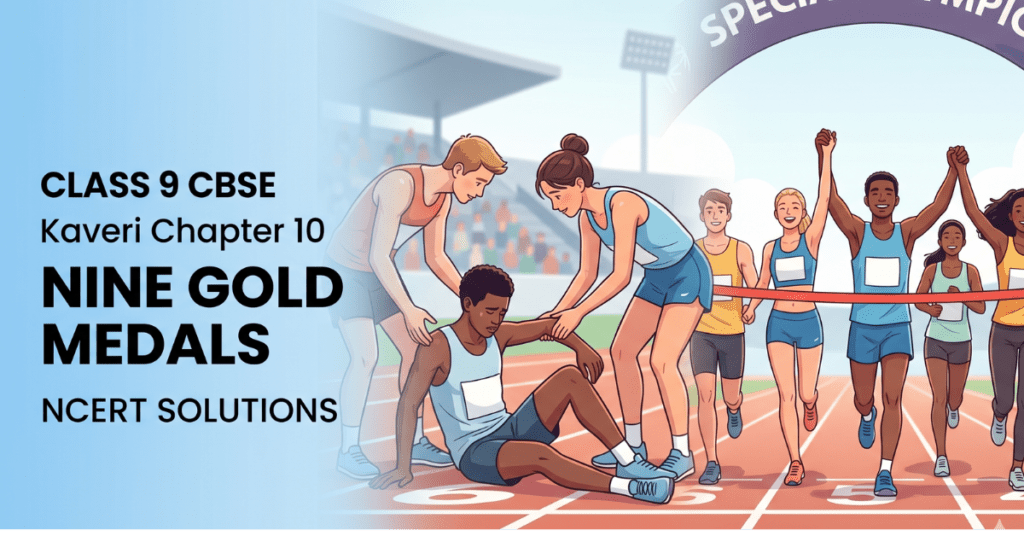
If you are preparing for Class 9 CBSE English, this chapter is important for understanding values like empathy, teamwork, and inclusion. Nine Gold Medals is based on a Special Olympics event where compassion becomes more important than winning.
Students often find value-based and interpretation questions challenging. This page provides complete NCERT solutions to help you write clear and structured answers in exams.
All sections are covered, including Reflect and Respond, Check Your Understanding, Critical Reflection, Vocabulary in Context, and Writing Task.
Reflect and Respond
I. “Work in pairs. Discuss the difference between Olympics, Special Olympics, and Paralympics.”
Answer:
The Olympics is an international multi-sport event where athletes compete at the highest level in different sports. It includes Summer and Winter Games and is held every four years.
The Paralympics is an international multi-sport event for athletes with disabilities. Para-athletes compete in many sports, and the event is held alongside the Olympics in the same year.
The Special Olympics provides sports training and athletic competitions for children and adults with intellectual disabilities, and it focuses strongly on acceptance, inclusion, participation, and personal growth.
II. “Work in pairs to match the words ‘empathy’, ‘sympathy’, and ‘compassion’ to the sentences given in the table below.”
Sentences in the table:
“I am so sorry for what is happening to you. It is sad, do you want something to eat?”
Answer: Sympathy
(Reason: The speaker feels sorry for the person and expresses sadness.)
“I can imagine how you feel. I understand that you are upset and why.”
Answer: Empathy
(Reason: The speaker tries to understand the feelings from the other person’s point of view.)
“I understand why you feel terribly low. I will spend some time with you, so that you don’t feel lonely.”
Answer: Compassion
(Reason: The speaker understands and also takes action to help and support.)
III. “Work in pairs. List the words you associate with ‘empathy’. Share your responses with your classmates and teacher.”
Answer (sample list):
Understanding, listening, caring, kindness, respect, patience, support, sensitivity, kindness, emotional awareness, helping, comfort, concern.
Check Your Understanding
I. “Work in pairs. Match the words and phrases in Column 1 with their meanings in Column 2. You may read the poem again and infer the contextual meaning. Check your answers with the teacher.”
Column 1 and Column 2 (from the page):
dashed in the dirt
stumbled
staggered
anguish
asphalt
(i) walk or move with difficulty
(ii) destroyed
(iii) a hard black substance used to make roads and paths
(iv) step awkwardly, lose balance and almost fall
(v) extreme pain or suffering
Answers:
dashed in the dirt — (ii) destroyed
stumbled — (iv) step awkwardly, lose balance and almost fall
staggered — (i) walk or move with difficulty
anguish — (v) extreme pain or suffering
asphalt — (iii) a hard black substance used to make roads and paths
II. “Identify the gist of each stanza. Write the number of the stanza in the boxes given.”
“Spectators cheered participants of different events and waited enthusiastically for the final event to start.”
Answer: 2
“All runners dashed ahead as soon as they heard the gun shot; suddenly, one of the athletes tripped and fell on the ground.”
Answer: 4
“The race finished with nine athletes holding hands and winning the well-deserved gold medals; their smiles, and spectators standing up to applaud, conveyed everything.”
Answer: 8
“Participants got ready at the starting line and nine determined athletes waited for the sound of the gun.”
Answer: 3
“Athletes from various parts of the country had gone through months of training; had big dreams of winning a medal.”
Answer: 1
“The eight athletes stopped to help the young fallen athlete stand up, forgetting that they were competing.”
Answer: 6
“Nine athletes held the banner and walked hand in hand; this gesture represented the ethos of Special Olympics.”
Answer: 7
“The young athlete felt his dreams were shattered and cried in pain and disappointment, but something unique happened.”
Answer: 5
III. Let us appreciate the poem.
- “Two examples of alliteration from the poem are (i) _ and (ii) _.”
Answer:
(i) “stood and staggered”
(ii) “dreams and his”
(Any other correct pair of repeated starting sounds from the poem is acceptable.) - “Give three examples of visual imagery from the poem. (i) _ (ii) _ (iii) __”
Answer:
(i) “The spectators gathered around the old field”
(ii) “The blocks were all lined up”
(iii) “They came to the finish line holding hands still” - “Give an example of auditory imagery from the poem. (i) _____”
Answer:
(i) “the pistol exploded” / “the sound of the gun” - “How does the use of imagery make the poem more appealing?”
Answer:
Imagery makes the poem more appealing because it helps the reader clearly imagine the scene. The reader can picture the field, the runners, the fall, and the final moment of the runners holding hands. The sound images, such as the pistol exploding, make the event feel real and exciting. - “How does the poet’s tone change from the beginning to the end of the poem?”
Answer:
At the beginning, the poet’s tone is energetic and competitive because the athletes are training and preparing to win medals. In the middle, the tone becomes painful and emotional when the young athlete falls and cries. At the end, the tone becomes inspiring and celebratory when all nine athletes walk together and finish the race holding hands. - “What is the overall mood created by the poem?”
Answer:
The overall mood is inspiring and uplifting. The poem finally creates a feeling of hope and goodness because kindness and teamwork become more important than winning. - “What is the message being conveyed by the poem?”
Answer:
The message of the poem is that compassion, inclusion, and helping others matter more than individual victory. True success is shown through humanity and collective support.
Critical Reflection
I. “Read the extracts given below and answer the questions that follow.”
Extract 1
“The eight other runners pulled up on their heels
The ones who had trained for so long to compete
One by one they all turned round and went back to help him
And brought the young boy to his feet.”
(i) “Select the correct option to complete the sentence. The phrase ‘pulled up on their heels’ means that the runners _.”
Options:
A. moved aside
B. stopped running
C. tried to run faster
D. jumped ahead
Answer: B. stopped running
(ii) “Mention one character trait common to all the eight other runners.”
Answer:
One common character trait is kindness. They cared about the fallen runner and helped him.
(iii) “What is the tone of the poet in these lines?”
Answer:
The tone is admiring and appreciative, because the poet respects the runners for helping instead of continuing the race.
(iv) “How might the young athlete have felt on being helped by the others?”
Answer:
The young athlete might have felt relieved, comforted, grateful, and encouraged, because he was not left alone after falling.
(v) “Would you consider this incident as a turning point in the poem? If yes, why? If no, why not?”
Answer:
Yes, it is a turning point because the poem shifts from competition to compassion. The act of helping changes the meaning of the race from winning medals to showing humanity.
Extract 2
“That’s how the race ended, with nine gold medals
They came to the finish line holding hands still
And a standing ovation and nine beaming faces
Said more than these words ever will.”
(i) “How did the nine contestants feel when they reached the finishing line together?”
Answer:
They felt happy, proud, united, and satisfied, because they finished together and supported one another.
(ii) “Why do you think all the nine contestants were given gold medals?”
Answer:
All nine contestants were given gold medals because they showed the true spirit of Special Olympics: inclusion, teamwork, empathy, and collective success rather than individual victory.
(iii) “Complete the sentence appropriately. The holding of hands signifies a feeling of _________.”
Answer:
The holding of hands signifies a feeling of unity and togetherness.
(iv) “Choose the correct option to complete the sentence. The spectators giving a ‘standing ovation’ indicates that they were _.”
Options:
A. amazed
B. speechless
C. distracted
D. thoughtful
Answer: A. amazed
(v) “Explain the last line of the extract.”
Answer:
The last line means that the powerful scene of nine runners finishing together, smiling, and receiving applause expresses the message better than any explanation. Their actions communicate compassion and unity more strongly than words can.
II. “Answer the following questions.”
- “Describe how the setting established in the first two stanzas of the poem create a vivid atmosphere for the events that follow.”
Answer:
The first two stanzas describe athletes coming from different places, training for months, and spectators gathering around the old field to cheer. This creates a vivid atmosphere of excitement, anticipation, and competition. It prepares the reader for the final event and makes the later moment of kindness more meaningful. - “How do you think the youngest athlete might have felt when he fell?”
Answer:
He might have felt intense disappointment, pain, embarrassment, and helplessness. He cried out in frustration because he felt his dreams and efforts were destroyed at that moment. - “Why were the athletes eager to begin the race?”
Answer:
They were eager because they had trained for weeks and months and wanted to prove their ability. They hoped to win medals and achieve their dream in the final event. - “What does the transformation of the hundred-yard dash to a walk symbolise?”
Answer:
It symbolises that compassion and unity are more important than speed and competition. The walk shows that helping someone and staying together is a greater victory than winning alone. - “How might the poem be different if the focus was solely on individual achievement rather than collective support?”
Answer:
If the poem focused only on individual achievement, the runners would have continued running and one person would have won while the fallen athlete would have lost alone. The poem would become a typical competitive sports story and would not convey the powerful message of empathy, inclusion, and teamwork. - “How does the poet’s use of language and tone enhance the reader’s engagement with the poem?”
Answer:
The poet uses simple, clear language and strong imagery such as the pistol exploding, the fall on asphalt, and the finish line with joined hands. The tone shifts from excitement to pain to inspiration, which keeps the reader emotionally involved and helps the reader feel the meaning of the event. - “What might be the poet’s purpose of writing this poem?”
Answer:
The poet’s purpose is to celebrate the true spirit of Special Olympics and to teach that kindness, empathy, and inclusion are greater than winning. The poem encourages readers to support others and value humanity.
Vocabulary in Context
I. “The phrase ‘standing ovation’ is an example of an adjective–noun collocation. Identify two other similar examples from the poem.”
Answer:
Two other adjective–noun collocations from the poem are:
“final event”
“nine beaming faces”
II. “Complete the table given below by writing four nouns in Column 2 that collocate with the adjectives in Column 1. One example has been done for you. You may take the help of a dictionary.”
Column 1
big (example already given: disappointment, failure, surprise, decision)
heavy
strong
large
great
Answers:
- heavy — rain, traffic, burden, suitcase
- strong — coffee, wind, smell, belief
- large — crowd, amount, number, house
- great — achievement, success, opportunity, responsibility
III. “Choose the correct adjectives from those given in the box for the underlined words given in the sentences below. Ensure you do not use the same adjective twice.”
Adjectives in the box: positive, significant, youngest, noisy, loud
“The littlest athlete was moving at a steady pace. _________”
Answer: youngest
“The eight athletes had a smiling attitude. _________”
Answer: positive
“When the athlete fell, he gave a huge cry of pain. _________”
Answer: loud
“The spectators saw a terrible difference in the athletes who had only come to compete. _________”
Answer: significant
“The gaudy crowd cheered the runners enthusiastically. _________”
Answer: noisy
Listen and Respond
I. “You will listen to a radio-talk about Patrick Gomes, a coach of special athletes. As you listen, write true or false for the statements given. (Transcript for teacher on page 268)”
“Patrick Gomes began his career in sports with track events.”
Answer: True
“Patrick Gomes has been coaching special athletes for 10 years.”
Answer: False (He has been coaching special athletes for more than fifteen years.)
“Patrick Gomes does all the household work himself.”
Answer: True
II. “You will listen to the radio-talk once again. As you listen, choose the correct option for each question.”
“When the speaker uses the phrase ‘push your boundaries’, he wants listeners to .”
Options: (i) challenge themselves (ii) meet new people (iii) be open-minded
Answer: (i) challenge themselves
“Patrick Gomes is a __ at present.”
Options: (i) special athlete (ii) coach of special athletes (iii) value education teacher
Answer: (ii) coach of special athletes
“Special Olympic Games held at Connecticut was a _ for Patrick Gomes.”
Options: (i) motivational year (ii) turning point (iii) gradual change
Answer: (ii) turning point
“As a special athlete, Patrick Gomes mostly participated in __.”
Options: (i) track events (ii) jogging (iii) football
Answer: (iii) football
“Patrick Gomes believes that sports is essential because it encourages _ along with fitness.”
Options: (i) a positive outlook (ii) a peaceful mind (iii) an active life
Answer: (i) a positive outlook
Speaking Activity
I. “Work in pairs. Take turns to express your points of view regarding Special Olympics. Use the key points given below to develop the conversation.”
Key points:
Importance of Special Olympics (promotes inclusion)
Impact of Special Olympics on sportspersons with special abilities
How to create awareness regarding Special Olympics
Answer (sample dialogue):
Student A: What is your opinion on Special Olympics?
Student B: Personally, I believe that Special Olympics is extremely important because it promotes inclusion and acceptance.
Student A: How do you feel about the impact of Special Olympics on sportspersons with special abilities?
Student B: From my perspective, it builds confidence, improves fitness, and gives athletes a chance to feel respected and valued.
Student A: In your view, is awareness about Special Olympics still low?
Student B: It is my belief that many people still do not know enough about it, so we should spread awareness through school assemblies, posters, and social media campaigns.
Student A: What is your take on how students can help?
Student B: I have a strong feeling that students can help by participating in inclusion drives, inviting speakers, and supporting events that celebrate Special Olympics.
Writing Task
I. “Work in pairs to write three creative slogans on Special Olympics. One example of a slogan on Special Olympics has been given below. Special Olympics: Igniting a Universe of Potential. Present your slogans in a creative manner and share with your classmates and teacher.”
Answer (three slogans):
Special Olympics: Every Athlete, Every Dream, Every Victory.
Special Olympics: Together We Rise, Together We Shine.
Special Olympics: Ability Wins When Inclusion Begins.
Learning Beyond the Text
I. “Read the information given below about some athletes who participated in Special Olympic Games 2023 held in Berlin, Germany. Find out more about other Indian achievers of Special Olympics.”
Answer (sample response):
Other Indian achievers in Special Olympics include athletes who have won medals in athletics, swimming, and other events across different years. India has produced medal winners in track and field, relay races, and various adapted events, showing strong participation and improvement in Special Olympics.
(If you want, tell me whether you need two achievers or five achievers, and I will list them in a neat point format.)
III. “Read the information given below in the infographic. Now, create an infographic on any sport and present it in the class.”
Answer (sample infographic content on “Badminton”):
BADMINTON: A GLIMPSE
Badminton is played with a racquet and a shuttlecock.
It can be played as singles or doubles.
The objective is to hit the shuttlecock over the net and make it land in the opponent’s court.
A match is usually played as the best of three games.
Each game is played up to twenty-one points.
Badminton improves stamina, speed, coordination, and reflexes
How to Use These NCERT Solutions
Read the poem carefully to understand the sequence of events and the emotional shift.
Try answering questions on your own first. Then compare your answers with the given ones.
Focus on themes like empathy, compassion, and teamwork because these are frequently asked in exams.
Why This Chapter is Important
This chapter highlights the true spirit of sports and human values.
It teaches that helping others and showing kindness is more important than individual success.
Questions from this chapter often test themes, tone, and moral understanding.
Who Should Use This
This content is useful for:
- Class 9 CBSE students
- Students preparing for English exams
- Learners focusing on value-based questions
- Students improving answer writing