
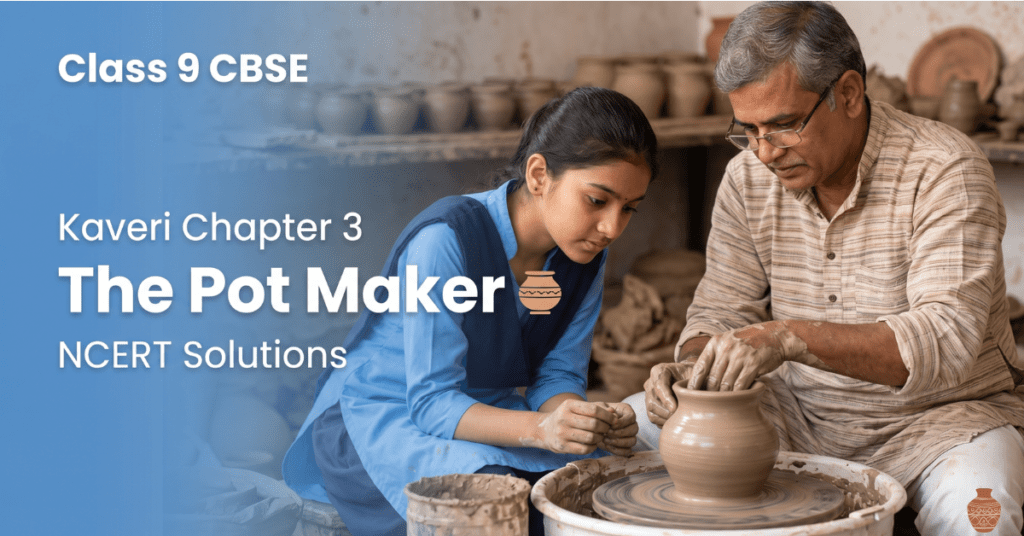







If you are preparing for Class 9 CBSE English, this chapter is important for understanding themes such as skill, perseverance, and the dignity of labour. The Pot Maker shows how traditional crafts require patience, practice, and dedication.
Students often find process-based and character questions difficult. This page provides complete NCERT solutions to help you understand answers clearly and improve your writing in exams.
All sections are covered, including Reflect and Respond, Check Your Understanding, Critical Reflection, Vocabulary and Structures in Context, Listen and Respond, and Writing Task.
Reflect and Respond
I Look at the pictures given below and identify the vocations. Now, list at least five more vocations.
Answer: The pictures show vocations such as potter, weaver, carpenter, and basket maker/craftsperson.
Five more vocations: tailor, blacksmith, farmer, mason, cobbler.
II Work in pairs. Discuss the following questions and share your answers with your classmates and teacher.
- What is common among these pictures?
Answer: All the pictures show people engaged in skill-based work or vocations. - We refer to such skill-based work as v__ _ a _ _ o _ s.
Answer: vocations - Mention a few differences between handmade and machine-made products.
Answer: Handmade products are usually unique, crafted with personal skill, and may take more time to make. Machine-made products are produced faster, in large numbers, and often look uniform.
Check Your Understanding
I Do you think pot making is easy? If yes, why? If no, why not?
Answer: No, pot making is not easy because it requires hard physical labour, patience, skill, timing, and precision. A small mistake in shaping or firing can ruin the whole batch.
II Would Sentila be able to fulfil her dream of becoming a pot maker? Explain.
Answer: Yes, Sentila would be able to fulfil her dream because she is deeply interested in pot making, watches the expert potters carefully, and is determined to learn.
III Do you think Mesoba and Arenla would support Sentila? Give a reason.
Answer: Yes, I think they would eventually support her. Mesoba already defends her before the village council, and Arenla is likely to support her because pot making is a family skill that must be passed on.
Check Your Understanding
I Do you think Onula’s support helped Sentila? If yes, why? If no, why not?
Answer: Yes, Onula’s support helped Sentila a great deal because she encouraged her, corrected her mistakes gently, and helped build her confidence.
II Sentila observes her mother making pots. What does this tell us about her?
Answer: This tells us that Sentila is patient, observant, eager to learn, and determined to master the craft.
III Arrange the following events of the story in the correct sequence. Share your answer with your classmates and teacher.
Answer: 4, 6, 3, 1, 8, 5, 2, 9, 7
Critical Reflection
I Read the extracts given below and answer the questions that follow.
- Pounding the stubborn clay inside bamboo cylinders to soften it, is also tedious. So many times I’ve dropped the mould out of sheer exhaustion and have had to start all over again. It takes months to bring out a batch of pots after so much labour. And the reward? A few rupees. But if Sentila learns weaving, she can make much more money besides providing enough cloth for the family. Weaving is not messy like pot making and can be done indoors in all seasons. Also, the time spent on weaving one shawl is much less and the return is handsome.
(i) Choose the correct reason for the given assertion.
(A): The effort in making pots is far greater than the returns.
A. The process of pot making is quite tiresome and long, and one hardly earns much.
B. The process of pot making is exhausting, takes a long time, yet gives a sense of satisfaction.
Answer: A. The process of pot making is quite tiresome and long, and one hardly earns much.
(ii) Why does Arenla want Sentila to learn weaving?
Answer: Arenla wants Sentila to learn weaving because it is cleaner, easier, less time-consuming, can be done indoors in all seasons, and brings better income.
(iii) State one advantage that weaving has over pot making, as per the extract.
Answer: One advantage is that weaving can be done indoors in all seasons.
(iv) Choose the sentence that uses the word ‘handsome’ in the same way as in the extract.
A. My father is a handsome man.
B. They will make a handsome profit selling this property.
Answer: B. They will make a handsome profit selling this property.
(v) ‘And the reward?’ What is the author’s purpose of using a question mark here?
Answer: The question mark is used to stress Arenla’s disappointment and to highlight how little reward comes after so much labour. - Onula saw her taking out some clay and the implements from her basket quietly. She watched Sentila’s clumsy efforts to make a pot and noticed that Sentila was too tense. As a result, the clay seemed unable or unwilling to yield the right shape. When Sentila wearily let the misshapen lump fall flat on the ground, Onula went to her and said, “Don’t worry, little one, I shall teach you how to make a perfect pot.” Sentila watched in amazement as Onula fashioned a beautiful pot and asked her to try again.
(i) Complete the sentence with an appropriate reason.
Onula feels Sentila’s effort at making a pot is clumsy because __.
Answer: Onula feels Sentila’s effort at making a pot is clumsy because she is too tense and does not yet know how to shape the clay properly.
(ii) Choose the correct option to complete the following sentence.
‘Don’t worry, little one, I shall teach you how to make a perfect pot.’
This shows that Onula was _.
A. sincere and generous
B. forgiving and thoughtful
C. thoughtful and generous
D. forgiving and sincere
Answer: C. thoughtful and generous
(iii) Which among the following is the effect of a cause?
A. As a result, the clay seemed unable or unwilling to yield the right shape.
B. Onula saw her taking out some clay and the implements from her basket quietly.
Answer: A. As a result, the clay seemed unable or unwilling to yield the right shape.
(iv) ‘Onula fashioned a beautiful pot.’ Here, the word ‘fashioned’ means __. (created/styled)
Answer: created
(v) How might Sentila have felt when she saw ‘the misshapen lump fall flat on the ground’?
Answer: Sentila might have felt disappointed, ashamed, and frustrated.
II Answer the following questions.
- Describe the process of pot making followed by expert pot makers, as observed by Sentila.
Answer: Sentila observed that the clay was first mixed with water and pounded. Then the potter pushed the left hand into the lump of softened clay and rotated it while shaping it with a spatula in the right hand. After a few days, the pots were given a final touch-up, dried in the sun, loaded into a kiln on a bed of hay and dried bamboo, covered again, and then fired carefully. - What warning was given to Mesoba by the village council?
Answer: The village council warned Mesoba to remind Arenla that pot making was a traditional skill handed down from generation to generation and that it was her duty to pass it on. - How did Sentila feel when she failed at pot making even after a year of training with her mother?
Answer: Sentila felt ashamed, frustrated, and discouraged. - ‘Onula stood there for a long time as if trying to absorb a new phenomenon’. Explain.
Answer: Onula stood there in wonder because she realised that Sentila had finally become a true pot maker. The two rows of pots were so similar that she could not tell them apart, and this revealed Sentila’s transformation. - ‘The tradition and history of the people did not belong to any individual,’ what does this symbolise?
Answer: This symbolises that traditional skills and crafts are part of the community’s shared cultural heritage and must be preserved and passed on. - What is the significance of the concluding line of the story, ‘A new pot maker was born’?
Answer: The concluding line signifies Sentila’s emergence as a true craftsperson and the continuation of the tradition of pot making. - What is the role of perseverance in pursuing one’s dreams? Elaborate with reference to Sentila.
Answer: Perseverance plays a very important role in pursuing one’s dreams. Sentila continues to love pot making despite discouragement, hard work, and repeated failure. Her patience, observation, and determination finally help her succeed. Her journey shows that dreams can be achieved through steady effort and persistence.
Vocabulary and Structures in Context
I Read the highlighted words in the following sentences from the text.
Now, classify the words/phrases given in the box as shown in the table below. One example for each category has been done for you.
Answer:
Tools/Implements — dao, spatula, basket, cylinders, kiln
Raw Materials — dough, clay, bamboo, bed of hay
Process — pounding, rotating, shaping
II Work in pairs and find the meanings of the following words related to economy. You may refer to a dictionary. Now, frame sentences using each word.
bankrupt — unable to pay debts
Sentence: The shopkeeper became bankrupt after heavy losses.
credit — the ability to buy now and pay later
Sentence: My father bought the machine on credit.
currency — the money used in a country
Sentence: The rupee is the currency of India.
debt — money that is owed
Sentence: The farmer worked hard to repay his debt.
fiscal — related to government revenue or finance
Sentence: The government announced a new fiscal policy.
inflation — a rise in prices over time
Sentence: Inflation has made everyday goods more expensive.
investment — money put into something to earn profit or gain
Sentence: Education is a good investment for the future.
interest — money paid for borrowing or earned on savings
Sentence: The bank gives interest on savings accounts.
III Read the following sentences from the text. The main clause has been underlined and the subordinate clause has been circled.
- Complete the following sentences with suitable noun clauses.
(i) The elders emphasised that ___________________.
Answer: The elders emphasised that pot making should be passed on from generation to generation.
(ii) Mesoba explained why ____________________.
Answer: Mesoba explained why Arenla had not yet taught Sentila pot making.
(iii) Onula’s promise was that __________________.
Answer: Onula’s promise was that she would teach Sentila how to make a perfect pot.
(iv) Sentila observed her mother carefully when she was shaping the mouth of the pot, which ________________.
Answer: Sentila observed her mother carefully when she was shaping the mouth of the pot, which showed that she was eager to learn every detail of the craft.
(v) The kiln, where _________, required careful attention to prevent over-or-under firing.
Answer: The kiln, where the pots were fired, required careful attention to prevent over-or-under firing. - Read the following sentences from the text. Underline the main clause and circle the subordinate clause.
(i) Arenla took Sentila to the riverbank where the grey and red clay was found.
Answer: Main clause — Arenla took Sentila to the riverbank
Subordinate clause — where the grey and red clay was found
(ii) She started on the next one, and like a sprinter who had suddenly found momentum…
Answer: Main clause — She started on the next one
Subordinate clause — who had suddenly found momentum
(iii) … skills such as pot making, which not only catered to the needs of the people…
Answer: Main clause — skills such as pot making did not belong to any individual
Subordinate clause — which not only catered to the needs of the people but also symbolised the tradition and history of the people - Complete the following sentences with suitable relative clauses.
(i) Sentila, whose __, practised the craft diligently.
Answer: Sentila, whose determination never faded, practised the craft diligently.
(ii) The village council, where __, sought an explanation for Arenla’s reluctance.
Answer: The village council, where the elders had gathered, sought an explanation for Arenla’s reluctance.
(iii) The potter’s hands, which __, shaped the clay into beautiful creations.
Answer: The potter’s hands, which moved with skill and precision, shaped the clay into beautiful creations.
(iv) Arenla, her mother, wanted her to learn weaving, which ____________.
Answer: Arenla, her mother, wanted her to learn weaving, which she believed was cleaner and more profitable.
(v) Mesoba went home and discussed the matter with Arenla, who _.
Answer: Mesoba went home and discussed the matter with Arenla, who later began teaching Sentila the craft. - (i) Find out some more determiners from the text.
Answer: the, some, many, her, their, one, those
(ii) Fill in the blanks with suitable determiners. The first two blanks have been done for you.
A. The florist arranged five bouquets for her clients, that were displayed in _ elegant floral shop.
Answer: an
B. The carpenter crafted _ unique tables, and _________ became the centrepiece in ________ furniture collection.
Answer: several, they, his
C. _ of _ apprentices in _ culinary class demonstrated _ knife skills during the intense cooking session.
Answer: Each, the, the, their
D. _ of _ sculptures were displayed at ___ art exhibition, showcasing _ diverse artistic skills.
Answer: Some, the, the, their
Listen and Respond
I You will listen to a man speak about stone statues. As you listen, complete the given paragraph by filling in the blanks with the exact words you listen to.
- A statue is carved to create a shape that is 1. _.
Answer: visually interesting - Among the many things stone is used for making stone 2. _ is one of them.
Answer: sculptures - India has some of the most 3. _ stone sculptures, as is obvious from its many stone monuments across the country.
Answer: fascinating and mesmerising
II You will now listen to the man speaking about some steps involved in making stone statues. As you listen, select the six correct steps out of the nine given.
Answer: 1, 3, 5, 6, 8, 9
Writing Task
Reflective Writing – Identifying Skills and Passion
I Follow the steps given below to create a write-up about your skills and passions.
Answer:
I have always been drawn to creative activities, especially drawing and designing. These activities are meaningful to me because they allow me to express my ideas and emotions in a personal way. I enjoy learning new techniques and improving little by little each day.
To develop my skills, I practise sketching regularly, watch tutorials, and take part in school art activities. I also try making posters, simple digital designs, and handmade crafts. These activities help me become more patient, observant, and confident.
Among my skills, I believe designing has the greatest potential to turn my passion into a profession. It combines creativity with practical use and can lead to careers in graphic design, fashion design, animation, and product design. It is a field where imagination and skill are both important.
For example, whenever I prepare charts or presentation covers for school, I enjoy choosing colours, layouts, and lettering. These experiences have shown me that I like creating things that are both useful and beautiful. They have also encouraged me to think of design as a possible career.
This reflection has helped me understand that my interests are not just hobbies but possible paths for the future. I have realised that with steady practice, dedication, and the right guidance, I can develop my skills further and turn my passion into a meaningful profession.
How to Use These NCERT Solutions
Read the story carefully to understand the process of pot making and Sentila’s journey.
Try answering the questions on your own before checking the answers. This will improve your thinking and writing.
Focus on themes like perseverance, skill development, and tradition because these are commonly asked in exams.
Why This Chapter is Important
This chapter highlights the importance of traditional skills and cultural heritage.
It shows how patience, observation, and practice help in mastering any skill.
Questions from this chapter often test comprehension, process explanation, and character development.
Who Should Use This
This content is useful for:
- Class 9 CBSE students
- Students preparing for English exams
- Learners improving answer writing
- Students focusing on story-based questions