



Choosing between R1 and R2 is not a question of rigour, but of fit—fit with student readiness, teacher capacity, and school culture. Both pathways lead to the same competencies; they differ in cognitive demand, scaffolding, and assessment design. For most Indian schools with heterogeneous classrooms, a dual-track mindset with flexible implementation is more effective than a rigid either–or choice.
When is each suited?
| Context Indicator | R1 Fit | R2 Fit |
| Student language exposure (home + school) | High, multilingual, reading culture present | Limited exposure; first-generation or low print environment |
| Classroom profile | Homogeneous or high-achieving cohorts | Mixed-ability, wide variance |
| Teacher readiness | Strong in discussion-led, literature-rich pedagogy | Needs structured routines and guided practice |
| School goal | Enrichment, олимpiad/competitive readiness, writing depth | Foundational fluency, consistency in outcomes |
How should schools assess student needs?
Adopt a baseline + continuous review model:
- Diagnostic (start of year):
- Reading: inference vs literal comprehension (short unseen + MCQs + 2 open responses)
- Writing: 120-word task (organisation, grammar, voice)
- Oracy: 2-minute structured talk (clarity, coherence)
- Early-term evidence (first 6–8 weeks):
- Error patterns in grammar (editing vs recognition)
- Response length and idea development
- Participation in discussions
- Decision rule (pragmatic):
- If ≥60% students struggle with open-ended responses but perform in guided tasks → lean R2
- If majority sustain inference, argument, and extended writing → lean R1
Should you create separate sections?
- Yes, where feasible (large cohorts): clearer pacing, targeted pedagogy.
- If not feasible:
- Run a common core with tiered tasks (R2 baseline, R1 extensions).
- Use flexible grouping within the same class (rotation: guided station vs seminar station).
Do you need differentiated materials?
Non-negotiable. Use parallel resources aligned to the same texts.
- R2 scaffolds:
- Cue-based writing frames, paragraph builders
- Guided grammar (MCQ → fill → short production)
- Extract-first literature worksheets
- R1 extensions:
- Open prompts, comparative questions, cross-text links
- Editing/omission drills, style imitation
- Seminar protocols and debate briefs
Implementation model (recommended)
- Term 1: Start all in a scaffolded (R2-lean) mode
- Term 2 onward: Differentiate pathways based on evidence
- Assessment: Blend formats—ensure exposure to both guided and open-ended items
Bottom line: Avoid labelling students; design responsive systems. Schools that combine data-led placement, flexible grouping, and differentiated materials will extract the best of both R1 (depth) and R2 (access), without creating inequity.
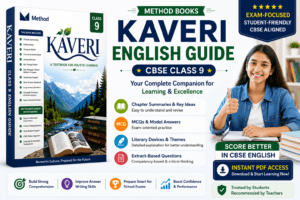
At Method Learners, we have designed books, study material, worksheets, question papers and teaching plans for R1 and R2 level to help you do the best for your students. We sincerely believe that CBSE’s latest curriculum gives us, as educators and educational facilitators, the exciting opportunity to reimagine the classroom environment.
We see the CBSE’s latest English curriculum as a practical opportunity for schools to strengthen classroom processes, streamline planning, and improve learning outcomes—especially in diverse, mixed-ability settings.
To support departments in this transition, we have developed a comprehensive, classroom-ready ecosystem for both R1 and R2 pathways. This includes:
- Structured teaching plans (day-wise, outcome-linked)
- Differentiated study materials and worksheets
- Assessment-ready question papers aligned with CBSE patterns
- Classroom management supports for handling varied learner levels
All our resources are fully aligned with CBSE guidelines and grounded in the principles of NCF-SE 2023, ensuring a balance between competency development, assessment readiness, and practical classroom feasibility.
For schools seeking tighter academic control and consistency, we also design:
- Customised midterm test papers, based on actual syllabus coverage
- Institution-specific assessment sets (printed and ready to administer)
- Flexible formats to match your internal timelines and evaluation needs
Our aim is simple: to reduce teacher load while improving instructional clarity, pacing, and student engagement—whether you are running separate R1/R2 sections or managing differentiation within the same classroom.
R1 vs R2 CBSE Question Paper Pattern
What are the key differences between CBSE R1 and R2 English?
What do the differences in R1 and R2 CBSE English curriculum 2026-27 mean for the students?
For samples, consultations, or customised support, write to us at methodlearners@gmail.com You can also request free sample materials to evaluate fit before adoption.