
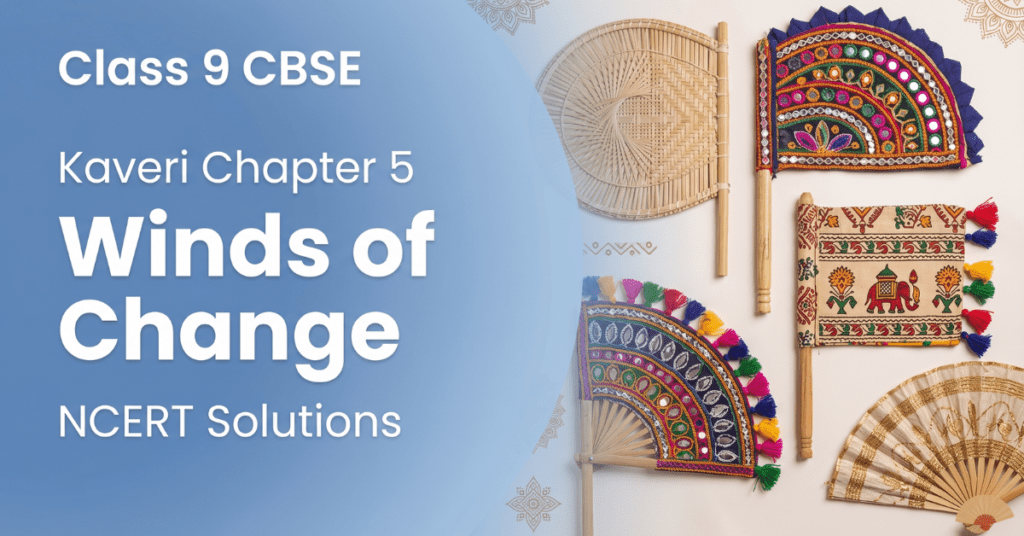



If you are preparing for Class 9 CBSE English, this chapter is important for understanding cultural heritage, traditional crafts, and changing economic roles. Winds of Change explores how pankhas reflect both utility and cultural identity.
Students often find analytical and inference-based questions difficult. This page provides complete NCERT solutions to help you understand answers clearly and improve your writing in exams.
All sections are covered, including Reflect and Respond, Check Your Understanding, Critical Reflection, Vocabulary and Structures in Context, Listen and Respond, Writing Task, and Learning Beyond the Text.How to Use These NCERT Solutions
Read the chapter carefully to understand how pankhas are linked to culture and economy.
Try answering questions on your own before checking the answers. This will help improve your analytical skills.
Focus on concepts like cultural identity, traditional craftsmanship, and modern changes because these are commonly asked in exams.
Reflect and Respond
I Does anyone in your family use a hand fan? What do you call it in your language? What is it made of?
Answer: Sample answer: Yes, hand fans are sometimes used in my family during hot weather or power cuts. We call it a pankha. It is usually made of palm leaf or bamboo.
II Work in pairs. Study the pictures given below carefully and complete the information. Discuss your answers with your classmates and teacher.
Answer:
Assam — Shape: round (inferred from the picture); Made of: not stated in the prose; the picture suggests bamboo/cane
Kerala — Shape: leaf-shaped / oval (inferred from the picture); Made of: Palm leaf
Uttar Pradesh — Shape: rectangular (inferred from the picture); Made of: Moonj grass
III Work in pairs. Match the underlined words in Column 1 with their meanings in Column 2 given on the next page. Share your answers with your classmates and teacher.
Answer:
indigenous — local — from where it originated
innovative — new and original in approach
industrious — hardworking
intricate — elaborate/detailed
invoked — brought out
initiatives — actions to improve a situation
Check Your Understanding
I Work in pairs to complete the table on pankha. Share your answers with your classmates and teacher.
Answer:
State
Type of Fan
Material Used
Rajasthan
appliqué hand fan
pieces of fabric sewn onto cloth with ornamental needlework
Rajasthan
zardozi hand fan
gold thread
Rajasthan
temple hand fans
brass
Gujarat
mirror work hand fans
pure cotton
Gujarat
beads hand fan
colourful beads and a silver handle
Gujarat (Kutch)
hand-stitched leather hand fan
leather, decorated with thread and wool
West Bengal
sola hand fans
sola
Uttar Pradesh
Phadh hand fans
pure gold, silver zari, silk and satin frills
Bihar
bamboo hand fans
bamboo
Critical Reflection
I Read the extracts given below and answer the questions that follow.
- Over time, pankhas became significant cultural goods…
(i) State whether the following sentence is true or false.
Pankhas were one of the most popular items of commerce.
Answer: False
(ii) Why has the word ‘traditional’ been used to describe pankhas?
Answer: The word ‘traditional’ has been used because pankhas have been used in India since ancient times and have developed as part of regional cultural practices over generations.
(iii) Complete the following statement.
The sentence ‘They were considered exotic and stylish’ is an opinion and not a fact because __________.
Answer: it expresses a personal judgement about pankhas and cannot be proved in the same way as an objective fact.
(iv) Infer one reason for commonality in the use of pankhas across India.
Answer: One reason is that pankhas were widely useful and suited the needs of people across different regions of India.
(v) Select which one of the two statements is the correct assertion for the given reason.
Reason: Pankhas were made of indigenous materials, unique to the region, with elaborate designs.
A. Each kind of pankha could be distinguished from the other.
B. Pankhas were used by many people.
Answer: A. Each kind of pankha could be distinguished from the other. - With time and the advent of technology and innovative creations…
(i) Infer one negative impact of technological advancement on pankha.
Answer: A negative impact is that pankhas are slowly losing their presence among Indians.
(ii) Complete the statement with an appropriate reason.
The writer refers to ‘pankhas’ not just as an object but as a ‘culture’ because _.
Answer: they carry stories, artistry, traditions, and regional identity, not just practical use.
(iii) Select a line from the extract which depicts how the role of the pankha has changed over the years.
Answer: “Once made for personal use, over time this handicraft has transformed into a commercial business and now provides some form of livelihood to India’s artisans.”
(iv) List one way in which the increase in demand of pankhas might benefit artisans.
Answer: It can provide artisans with livelihood.
(v) Select the factor that has contributed to the commercialisation of pankhas.
A. cultural preservation
B. economic demand
C. technological advancements
D. artisan initiative
Answer: B. economic demand
II Answer the following questions.
- How does the title ‘Winds of Change’ capture the essence of the chapter?
Answer: The title is appropriate because it refers both to the literal wind created by pankhas and to the changes in their role over time. Pankhas have moved from being objects of everyday personal use to decorative and commercial craft items. - Support the following statement with any two relevant examples from the chapter.
‘The structure and design of pankhas are testimony to the cultural identity of the region.’
Answer:
The appliqué hand fan of Rajasthan is made of pieces of fabric sewn in patterns with ornamental needlework.
The mirror work hand fans of Gujarat and the Phadh hand fans of Uttar Pradesh reflect local materials and decorative traditions. - The chapter mentions pankhas running the risk of slowly losing their presence among Indians. Evaluate how the balance between preserving traditional craftsmanship and incorporating innovative designs in the creation of pankhas will help in this regard.
Answer: Preserving traditional craftsmanship protects the cultural identity and inherited skills linked to pankha-making, while innovative designs can increase their appeal and usefulness in modern times. This balance can help keep the craft relevant and support artisans. - How might initiatives such as pankha-making workshops contribute to the preservation of this traditional craft?
Answer: Such workshops can spread awareness, teach people about the beauty and importance of the craft, and help preserve traditional techniques by passing them on. - The writer mentions celebrating pankhas in the concluding part of the chapter. Assess how this could be beneficial to artisans and the craft.
Answer: Celebrating pankhas can help artisans display their skill, regain popularity for the craft, and access a wider commercial platform. This supports both artisans and the survival of the craft. - How does the restriction of the use of pankha for decorative purposes reflect the changing cultural role of these traditional fans in modern India?
Answer: It shows that pankhas are no longer used mainly as everyday cooling devices. Instead, they are increasingly valued as decorative, artistic, and cultural objects.
Vocabulary and Structures in Context
I Read the following pairs of words from the text.
- Classify the pairs of words given above in the following categories. One example has been done for you.
Answer:
Appearance
Place
Material
exotic and stylish
villages and towns
thread and wool
ornate and encrusted
within and outside
silk and brass
Now, find more such word pairs from the text and share them with your classmates and teacher.
Answer: gods and kings; shapes and sizes; culture and stories; beauty and importance.
II Find the word pairs for the following fixed expressions. Write the meanings of these expressions by selecting them from the box given below. One example has been done for you.
Answer:
high and dry
cut and run
facts and figures
all and sundry
wear and tear
time and again
through thick and thin
hard and fast (extra expression)
Meanings:
(i) in a difficult situation, without help or money — high and dry
(ii) the damage to object due to normal use — wear and tear
(iii) accurate and detailed information — facts and figures
(iv) even when there are problems or difficulties — through thick and thin
(v) everyone, not just a few special people — all and sundry
(vi) often; on many or all occasions — time and again
(vii) to make a quick or sudden escape — cut and run
III Read the following word combinations from the text.
- Choose the appropriate word collocations for the following sentences.
(i) The students have to (take/give) the English exam tomorrow.
Answer: take
(ii) The interviewer asked the candidate to (take/have) a seat.
Answer: have
(iii) My scooter (dashed against/ran into) a car.
Answer: ran into
(iv) I must (take/own) responsibility for my success.
Answer: take
(v) I would like to (tone up/improve) my grammar.
Answer: improve
IV Now, fill in the blanks with the present perfect form of verbs in the following paragraph. One example has been done for you.
Answer:
(i) have created
(ii) have mastered
(iii) has evolved
(iv) have passed
(v) have performed
Listen and Respond
I You will listen to a dialogue between a boy and a girl discussing which type of pankha they should choose as a gift. As you listen, choose four statements out of seven that are true from 1–7 given below.
Answer: 1, 2, 3, and 6.
Reasoning from the transcript: the boy says Grandma likes things with “a bit of weight,” remembers that she likes sitting in the veranda in the evenings, and the girl finally narrows the choice to “the lightweight bamboo one with the delicate beadwork” or “the medium-weight embroidered one with the mirror work.” They also decide to ask Mom, so statement 7 is false.
Writing Task
I Describe an artefact you have made in your craft class or learnt from someone.
Begin with collection and organisation of the facts with the help of the pointers given above. Do not include your opinion in the factual description.
Answer:
A paper hand fan is a small handheld artefact made from coloured paper, a wooden stick, glue, and thread. It is usually semicircular in shape and light in weight. To make it, a rectangular sheet of paper is folded into equal pleats and then fixed at one end. A stick is attached to serve as the handle. The outer surface may be decorated with patterns, colours, or borders. This artefact is used for creating airflow by hand and is easy to carry and store. It is commonly made in craft classes and can also be used during hot weather.
Learning Beyond the Text
I Identify any art or craft item from your region and make a presentation describing its features, materials, and process involved in making it, its usage, etc.
Answer: Sample presentation on Madhubani painting
Name of the object: Madhubani painting
Physical characteristics: colourful, detailed, often filled with geometric and floral patterns
Materials used: handmade paper or cloth, natural or poster colours, brushes or nib pens
Region: Bihar
Traditional use: used to decorate walls and floors during festivals and special occasions
Origin/evolution: it began as a folk art tradition and is now also practised on paper and canvas
Present use: used for decoration, exhibitions, greeting cards, and cultural display
II You can also make your own hand fan. Take ideas from the pictures given below and in groups of four, make your own hand fan. Display the hand fans in the class and describe the process used to make it.
Answer: Sample process for making a paper hand fan
Take a rectangular coloured sheet of paper.
Fold it into equal pleats from one end to the other.
Tie or glue one end firmly.
Fix a stick or handle at the tied end.
Open the folds into a fan shape.
Decorate the outer side with colours or patterns.
Let it dry before use.
How to Use These NCERT Solutions
Read the chapter carefully to understand how pankhas are linked to culture and economy.
Try answering questions on your own before checking the answers. This will help improve your analytical skills.
Focus on concepts like cultural identity, traditional craftsmanship, and modern changes because these are commonly asked in exams.
Why This Chapter is Important
This chapter highlights the importance of preserving traditional crafts in a modern world.
It shows how cultural objects can evolve over time and gain new roles in society.
Questions from this chapter often test comprehension, inference, and application of ideas.
Who Should Use This
This content is useful for:
- Class 9 CBSE students
- Students preparing for English exams
- Learners improving answer writing
- Students focusing on analytical questions