
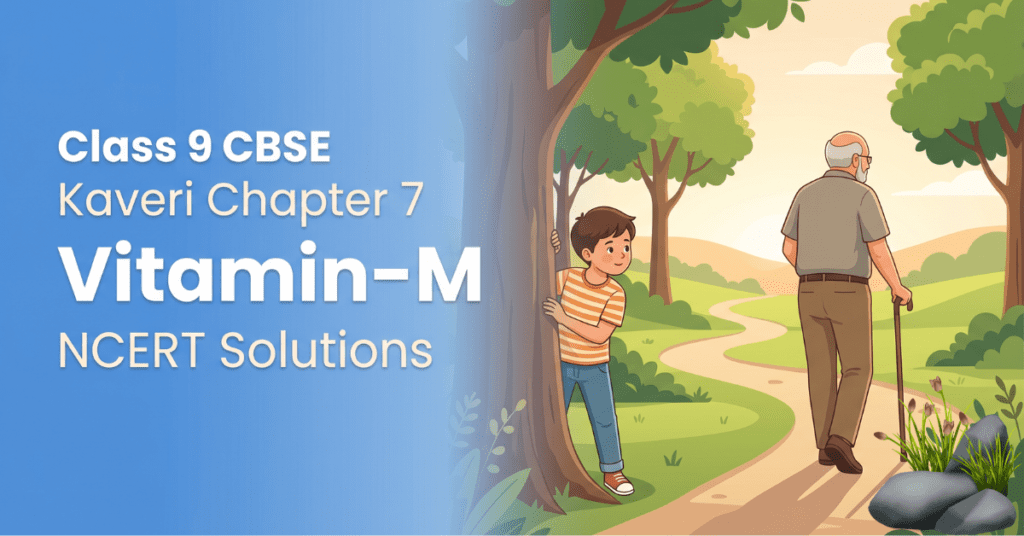


If you are preparing for Class 9 CBSE English, this chapter is important for understanding themes like care for the elderly, independence, and emotional relationships. Vitamin-M highlights how assumptions about age can be misleading.
Students often find story-based interpretation and character questions difficult. This page provides complete NCERT solutions to help you understand answers clearly and improve your writing.
All sections are covered, including Reflect and Respond, Check Your Understanding, Critical Reflection, Vocabulary and Structures in Context, Speaking Activity, and Writing Task.
Reflect and Respond
I From your experience with an elderly person at home or in your neighbourhood, complete the following graphic organiser.
Now, discuss the points written in the organiser with your classmates and teacher.
Answer:
Why should we care for the elderly? — They cared for us, they need support, they have valuable experience, and they deserve love and respect.
What are the problems faced by the elderly? — Weak health, poor memory, loneliness, hearing and sight problems, and difficulty in moving around.
What could be the possible reasons for the problems faced? — Old age, illness, loss of a companion, physical weakness, and reduced independence.
How can we take care of the elderly? — Spend time with them, speak patiently, help with medicines, accompany them when they go out, and make them feel safe and valued.
II Fill in the table given below. You may check your answers with the help of a dictionary.
- frail — weak and delicate
- shuddered — trembled because of fear or shock
- poky — small, cramped, and uncomfortable
- forbid — refuse to allow; prohibit
- pottering — moving around doing small tasks in a relaxed way
- winced — made an expression of pain or embarrassment
III Think of a tradition, story, or recipe passed down by grandparents or an elderly relative in your family. What does it mean to you? How does it connect you to your growing-up years? Share with your classmates and teacher.
Answer: Sample answer: A story my grandmother often told me was about honesty and kindness. It means a lot to me because it reminds me of my childhood evenings spent with her. It connects me to my growing-up years by bringing back memories of family warmth, love, and learning values through stories.
Check Your Understanding
I Why did Grandpa dislike living in the city with his daughter?
Answer: Grandpa disliked living in the city because it was noisy, crowded, and the flat was small and uncomfortable. He missed his quiet brick house and the peaceful life there.
II Why did Vidya not want her father to go out alone?
Answer: Vidya did not want her father to go out alone because he had begun to forget things, had once taken a double dose of his medicines, and had earlier lost his way while returning home.
III Was Ravi in favour of his mother treating Grandpa like a child? How can you say so?
Answer: No, Ravi was not in favour of it. We can say so because he winced when his mother spoke too loudly to Grandpa as if he were a child who could not hear or understand.
IV Would Ravi be able to keep up his promise to his mother?
Answer: Ravi tried to keep up his promise by secretly following Grandpa to make sure he came to no harm, but it was not easy for him.
Check Your Understanding
I Complete the flow chart by describing Grandpa’s day out.
Answer:
children’s park
peanuts
tea stall
the little boy’s mother and the vendors
tea and bananas and ice cream
barber shop
bus stop and boards a bus
II Was Grandpa lost as feared by Ravi’s mother?
Answer: No, Grandpa was not lost.
III How would Ravi feel after seeing Grandpa?
Answer: Ravi would feel relieved, delighted, and deeply affectionate towards Grandpa.
IV Do you think Ravi’s mother will get to know about what had happened?
Answer: She may not know the full truth, because Grandpa cleverly covers up the incident and Ravi keeps quiet out of embarrassment.
Check Your Understanding
I Describe how Ravi’s emotional reaction upon finding Grandpa safe at home reveals his feelings towards his grandfather.
Answer: Ravi’s reaction shows that he truly loves and cares for his grandfather. His relief, delight, and sudden affection reveal how deeply attached he is to him.
II What might be the significance of Grandpa’s habit of giving gifts to everyone on his birthday rather than receiving them?
Answer: This habit shows Grandpa’s generosity, affection, and joy in giving. It also shows that he values his family and still thinks lovingly of them as his own children.
III Why do you think Grandpa gave Ravi a detective story book as a gift? What might this suggest about Grandpa’s awareness of Ravi’s actions earlier in the day?
Answer: Grandpa gave Ravi a detective story book to tease him playfully. It suggests that Grandpa was aware that Ravi had been following him and knew that Ravi had been fooled.
Critical Reflection
I Read the extracts given below and answer the questions that follow.
- Grandpa hated the noise and bustle of city life and when they were on their own, he often spoke longingly of his small brick house in town. “Such a wonderful place…! With that big mango tree in the garden! It is so quiet that at dusk you can even hear a leaf fall!” But then Grandpa had slipped and fallen in the garden late one evening while he was pottering around and lain outside all night because there was no one at home to help him up.
(i) Choose the emotion displayed by the Grandfather.
A. regretful
B. apologetic
C. nostalgic
D. wistful
Answer: D. wistful
(ii) Complete the following sentence with a reason.
Grandpa hated the busy and noisy city life because _.
Answer: because it was crowded, noisy, and very different from the quiet and peaceful house he loved.
(iii) Why did Grandpa come to the city despite his dislike for city life?
Answer: Grandpa came to the city because he had fallen in his garden and there was no one there to help him, so his daughter brought him to live with her for safety.
(iv) Choose an expression similar in meaning to, ‘you can even hear a leaf fall’.
A. end of one’s life
B. arrival of autumn
C. sign of good luck
D. pin drop silence
Answer: D. pin drop silence
(v) State one advantage and one disadvantage of the Grandfather living in the house in town.
Answer:
Advantage — He enjoyed peace, quiet, and independence there.
Disadvantage — There was no one nearby to help him in an emergency. - “I had a quiet morning, but I don’t know about Ravi. He just disappeared instead of staying at home to look after me like you told him to,” answered Grandpa coolly, while Ravi just looked confused and embarrassed. Grandpa had another surprise for Ravi. A gift-wrapped parcel! “But, Papa, Ravi’s birthday was three months ago. Have you forgotten?” exclaimed Ravi’s mother, impatiently.
(i) Choose the option that displays the tone of the Grandfather’s response.
A. apologetic
B. hurtful
C. calm
D. puzzled
Answer: C. calm
(ii) Why was Ravi confused and embarrassed?
Answer: Ravi was confused and embarrassed because Grandpa cleverly blamed him in front of his mother, and Ravi knew that he had actually been following Grandpa secretly all morning.
(iii) Complete the sentence with a suitable reason.
Ravi’s mother was impatient because ________.
Answer: she thought Grandpa had forgotten Ravi’s birthday and did not understand why he was giving him a gift then.
(iv) State whether the following sentence is true or false.
Grandfather forgot that Ravi’s birthday was three months ago.
Answer: False
(v) Why did Grandpa say he didn’t know what kind of morning Ravi might have had?
Answer: Grandpa said this to tease Ravi and indirectly show that he knew Ravi had not stayed at home but had followed him instead.
II Answer the following questions.
- Grandpa is portrayed as a person with failing memory in the beginning of the story. Give two evidences to disprove the statement.
Answer: First, Grandpa clearly remembered his custom of giving gifts to everyone on his birthday. Second, he cleverly hinted through Ravi’s gift that he knew Ravi had followed him. - Give two characteristic traits of each of the following characters.
(i) Grandfather — independent, clever
(ii) Ravi — caring, curious
(iii) Ravi’s mother — loving, anxious - Why was Ravi worried about what Grandfather had at the tea stall?
Answer: Ravi was worried because Grandpa drank sugary tea and ate bananas and ice cream, all of which were things he was not supposed to have at home. - Do you think it was easy for Ravi to follow his Grandfather? If yes, why? If no, why not?
Answer: No, it was not easy. Ravi had to hide repeatedly, was scolded by strangers, got embarrassed, struggled to keep up, and was finally tricked. - ‘Ravi is a good detective’. Give one argument in favour of and against the given statement.
Answer:
In favour — Ravi carefully followed Grandpa and observed his movements closely.
Against — Ravi was easily noticed by others and was eventually fooled by Grandpa’s trick with the yellow cap. - Was Grandfather aware that Ravi was following him? How do you know?
Answer: Yes, Grandfather was aware. We know this because he gave Ravi a detective story book and jokingly referred to “how to avoid getting fooled when one is trailing a suspect.” - In your opinion, who needs Vitamin-M? And why?
Answer: Ravi’s mother seems to need Vitamin-M, because she forgot her father’s birthday even though she believed that his memory was the weak one. - Some people believe society shows bias based on age (being young or old). Give an example where you might have experienced or observed such discrimination, when opinions were disregarded because of age.
Answer: Sample answer: Sometimes older people are treated as if they cannot decide things for themselves, even when they are capable. Similarly, young people’s ideas are sometimes ignored just because they are considered too inexperienced.
Vocabulary and Structures in Context
I Classify the words given in the box on the next page into movement words in Column 1 and sound words in Column 2. One example has been done for you.
Answer:
Movement words — pottering, twirling, crouch, crawl, creeping, ducked, zigzagging, evicted, briskly, sprinting, jumping, darted, trailing
Sound words — boomed, bustle, thudded, shrieks, whirr, grunted, snoring
Now, fill in the blanks with appropriate words from Column 1 or Column 2.
Answer:
trailing
bustle
briskly
thudded
twirling
crouch
creeping
grunted
darted
whirr
II Study the highlighted word in the given sentence from the text and fill in the boxes with synonymous words. You may refer to a dictionary.
Off he went, twirling his walking stick jauntily, leaving Ravi in a dilemma.
Answer:
QUANDARY
PREDICAMENT
III Fill in the table given below. Check your answers with the help of a dictionary.
- craftily — cleverly; adverb; synonym: cunningly; antonym: honestly
- dilemma — a difficult situation or choice; noun; synonym: quandary; antonym: certainty
- furious — very angry; adjective; synonym: enraged; antonym: calm
- boomed — spoke in a loud deep voice; verb; synonym: thundered; antonym: whispered
- humiliation — shame or embarrassment; noun; synonym: disgrace; antonym: honour
- attire — clothes; noun; synonym: outfit; antonym: undress
IV Match the emotions/expressions in Column 1 with their meanings in Column 2. One meaning is extra.
Answer:
embarrassed — (v) felt uncomfortable
countered — (iv) reply to an argument
flushed — (vi) became red in the face
stricken — (i) affected severely by an unpleasant feeling
gleam — (iii) expression of emotion
Extra meaning — (ii) to be confused
V Read the highlighted words in the following phrases from the story. Now, revisit the story and underline the prepositions.
Now, fill in the blanks with appropriate prepositions.
Answer:
(i) through
(ii) over
(iii) near
(iv) in
(v) along
(vi) towards
VI Read the following dialogues from the story.
Now, choose the correct answer.
A. The words in the quotes are (i) _ (exclamatory/interrogative) sentences.
Answer: interrogative
B. Sentences 1, 4, and 5 are (ii) _ (Wh-/Yes, No type) interrogative sentences.
Answer: Yes/No type
C. Sentences 2 and 3 are (iii) __ (Wh-/Yes, No type) interrogative sentences.
Answer: Wh- type
So, there are (iv) _ (two/three) types of interrogative sentences.
Answer: two
VII Read the following conversation.
Now, complete the following sentences in reported speech.
Answer:
helped in taking care of her grandparents at home
took turns making sure they were alright
if he had grandparents living with him
he and his parents visited his grandpa
how they managed their grandparents’ medical needs
had a schedule for giving medications and visits to the doctor
Listen and Respond
I You will listen to a podcast on meditation. As you listen, complete the sentences with not more than three exact words that you hear.
- Meditation is a form of yoga that usually refreshes the mind and helps with _______.
Answer: stress management - Meditation leads to a better health condition both _______.
Answer: physically and emotionally - Meditation also aids in lessening undesirable feelings and improving _______.
Answer: self-awareness - It is advised that we meditate every day so that it becomes a ___.
Answer: routine - Meditating on a daily basis is beneficial in comfortably tackling ____.
Answer: exam-related pressure
Speaking Activity
I Now, revisit the story and select different questions. Work in pairs and practise speaking them aloud according to the examples shared.
Answer: This is an oral classroom activity.
II Make a presentation about a brief personal experience related to taking care of an older person.
Answer: Sample presentation:
The person I had the privilege of taking care of was my grandmother when she was unwell for a few days. I helped by giving her water, bringing her medicines, and sitting with her so that she would not feel lonely. Through this experience, I discovered that I can be patient and responsible. I also understood that older people may need emotional support as much as physical help. Caring for her made me appreciate her strength and helped me understand some of the difficulties of ageing.
Writing Task
I As you read in the story, we have a lot to learn from our elderly. Based on the lessons learned from them, write an article for your school magazine on the topic ‘Our Inspiring Elderly’.
Answer:
Our Inspiring Elderly
ABC, Class IX
The elderly are a valuable part of our families and society. They are a source of wisdom, experience, love, and guidance. Even when age brings physical weakness, their strength of character and their life lessons continue to inspire us.
Many older people inspire us through their courage, patience, and dignity. They teach us the importance of responsibility, kindness, and resilience. Some have struggled through difficult times, cared for their families selflessly, and continued to face life with determination. Their stories, habits, advice, and values help shape the younger generation. Their lives remind us that true strength lies not only in physical ability but in wisdom and endurance.
The elderly also inspire us by showing how challenges can be overcome. Even when they face poor health, loneliness, or loss, many remain hopeful and caring. Their ability to adapt, support others, and preserve family traditions leaves a deep impact on us. They make us realise the importance of respect, empathy, and gratitude.
Our elderly deserve not only our care but also our admiration. They are living examples of courage, experience, and love. By listening to them and learning from them, we become better human beings. We must value them, spend time with them, and remember that they are one of our greatest sources of inspiration.
How to Use These NCERT Solutions
Read the story carefully to understand the sequence of events and character behaviour.
Try answering questions on your own before checking the answers. This will help improve your thinking and writing.
Focus on character traits, tone, and themes because these are commonly asked in exams.
Why This Chapter is Important
This chapter focuses on care, independence, and understanding elderly people.
It shows how assumptions about age can be wrong and highlights emotional bonds within a family.
Questions from this chapter often test comprehension, character analysis, and values.
Who Should Use This
This content is useful for:
- Class 9 CBSE students
- Students preparing for English exams
- Learners improving answer writing
- Students focusing on story-based questions