


For a Head of Department or teacher, the PDF is not just a syllabus document—it is a shift document. The key is to focus on what has changed in practice, not just what is listed. The following areas deserve close, deliberate attention:
1. Competency-Based Framing (Not Content Coverage)
- Curricular Goals (CGs) and Competencies (Cs) are the real drivers of teaching and assessment.
- Planning must move from “finishing chapters” to “demonstrating competencies” (e.g., argumentation, interpretation, writing for real contexts).
2. R1 vs R2 Structural Differences
- R1 includes cultural-linguistic awareness (CG-4); R2 does not.
- The order of goals (literary vs reasoning) is different—this affects lesson sequencing.
- This is a signal for differentiated pedagogy, not just separate papers.
3. Assessment Shift: From Recall to Application
- Strong emphasis on:
- Interpretation, analysis, and reasoning
- Case-based questions and extract analysis
- Constructed responses over rote answers
- You must redesign internal assessments accordingly (not just reuse old papers).
4. Writing for Real-Life Contexts
- Writing tasks are functional and authentic (emails, notices, speeches, articles).
- Students must learn:
- Purpose
- Audience
- Format
- This requires explicit teaching of formats, not just practice.
5. Integration of Oracy (Listening & Speaking)
- Oracy is not optional—it is a core outcome.
- Activities like debates, discussions, presentations must be:
- Planned
- Assessed
- Most schools under-implement this—this is a gap area.
6. Experiential and Discussion-Based Pedagogy
- Clear push toward:
- Inquiry-based learning
- Group work and projects
- Student voice and participation
- This impacts:
- Classroom layout
- Time allocation
- Teacher role (facilitator, not lecturer)
7. Grammar in Context (Not Isolated Drills)
- Grammar is embedded in:
- Editing
- Transformation
- Writing tasks
- Teaching must shift from rule memorisation to application in context.
8. Internal Assessment as Continuous Evidence
- Portfolio, projects, and multiple assessments are core components, not add-ons.
- Requires:
- Clear rubrics
- Documentation
- Regular feedback cycles
9. Flexibility of Textbook Use
- Same textbook for R1 and R2, but transaction differs.
- This puts pressure on schools to:
- Differentiate tasks
- Adjust depth and pacing
Pay attention to how teaching, assessment, and classroom roles must change.
If a school only updates its question papers but not its pedagogy, task design, and assessment practices, it will miss the intent of the document.
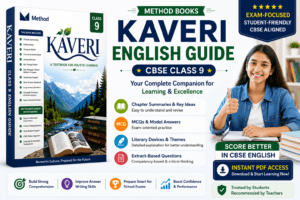
At Method Learners, we have designed books, study material, worksheets, question papers and teaching plans for R1 and R2 level to help you do the best for your students. We sincerely believe that CBSE’s latest curriculum gives us, as educators and educational facilitators, the exciting opportunity to reimagine the classroom environment.
We see the CBSE’s latest English curriculum as a practical opportunity for schools to strengthen classroom processes, streamline planning, and improve learning outcomes—especially in diverse, mixed-ability settings.
To support departments in this transition, we have developed a comprehensive, classroom-ready ecosystem for both R1 and R2 pathways. This includes:
- Structured teaching plans (day-wise, outcome-linked)
- Differentiated study materials and worksheets
- Assessment-ready question papers aligned with CBSE patterns
- Classroom management supports for handling varied learner levels
All our resources are fully aligned with CBSE guidelines and grounded in the principles of NCF-SE 2023, ensuring a balance between competency development, assessment readiness, and practical classroom feasibility.
For schools seeking tighter academic control and consistency, we also design:
- Customised midterm test papers, based on actual syllabus coverage
- Institution-specific assessment sets (printed and ready to administer)
- Flexible formats to match your internal timelines and evaluation needs
Our aim is simple: to reduce teacher load while improving instructional clarity, pacing, and student engagement—whether you are running separate R1/R2 sections or managing differentiation within the same classroom.
R1 vs R2 CBSE Question Paper Pattern
What are the key differences between CBSE R1 and R2 English?
What do the differences in R1 and R2 CBSE English curriculum 2026-27 mean for the students?
For samples, consultations, or customised support, write to us at support.methodlearners@gmail.com You can also request free sample materials to evaluate fit before adoption.