
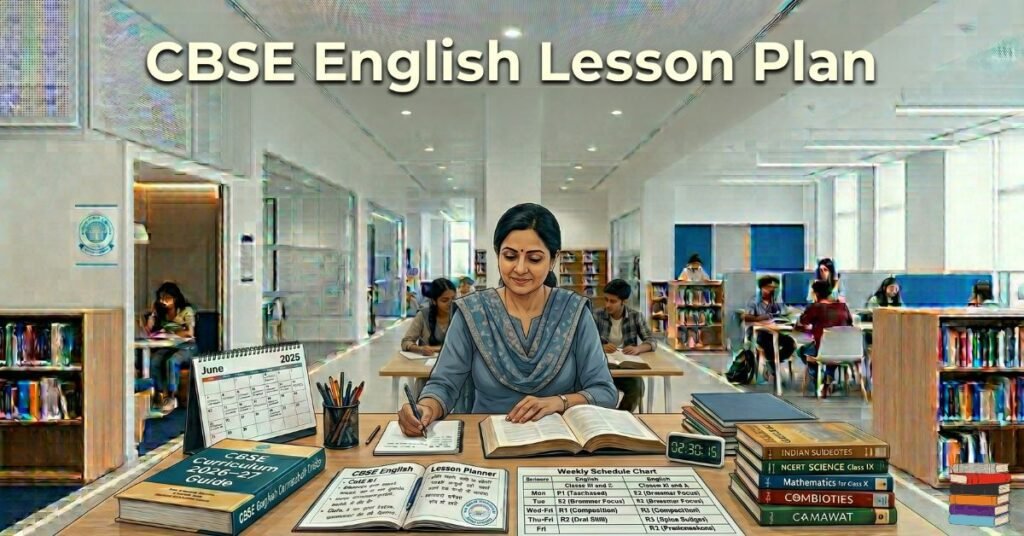

An ideal CBSE Lesson Plan is no longer a simple timetable of chapters. It is a competency-driven roadmap that integrates skills, assessment, and pedagogy while remaining flexible for diverse learners (R1/R2).
1. Core Components of an Ideal Lesson Plan
Every lesson plan must include:
- Curricular Goals & Competencies Mapping
Link each lesson to specific CGs and competencies (communication, reasoning, literary appreciation). - Unit-wise Learning Outcomes
Clear, measurable outcomes (e.g., “students will infer tone,” “write a formal email with structure”). - Integrated Skill Approach
Combine Reading, Writing, Listening, Speaking, Grammar within each unit. - Pedagogical Strategy
Activity-based, discussion-led, experiential (debates, role play, group tasks). - Differentiation Plan (R1/R2)
- R2: guided tasks, structured worksheets
- R1: open-ended, analytical extensions
- Assessment Plan
- Formative: quizzes, discussions, portfolios
- Summative: unit tests, term exams
- Time Allocation & Pacing
Realistic weekly/monthly breakup
2. Annual Time Breakup (Recommended)
Assuming ~120–140 teaching periods/year (35–40 minutes each):
| Component | Approx % | Periods/Year | Focus |
| Literature (Prose + Poetry + Drama) | 35% | 45–50 | Reading, interpretation, discussion |
| Writing Skills | 20% | 25–30 | Formats + practice |
| Grammar (in context) | 15% | 18–22 | Application-based |
| Reading Skills (Unseen) | 10% | 12–15 | Comprehension strategies |
| Listening & Speaking (Oracy) | 10% | 12–15 | Presentations, debates |
| Assessment & Revision | 10% | 12–15 | Tests, feedback |
3. Monthly / Term-wise Syllabus Breakup
Term 1 (April–September)
- 50–55% syllabus coverage
- Focus on foundation building
| Area | Time Focus |
| Literature | 5–6 chapters + 4–5 poems |
| Writing | Notice, letter, basic article |
| Grammar | Core rules (tenses, modals, SVA) |
| Oracy | Introduce discussions, short presentations |
| Assessment | 1 unit test + Midterm |
Term 2 (October–February)
- Remaining 45–50% syllabus
- Focus on depth + exam readiness
| Area | Time Focus |
| Literature | Remaining chapters + deeper analysis |
| Writing | Essay, speech, advanced formats |
| Grammar | Application + editing |
| Oracy | Debates, formal presentations |
| Assessment | 1–2 unit tests + Final exam |
4. Weekly Planning Model (Sample)
| Week Structure | Focus |
| 2 periods | Literature (reading + discussion) |
| 1 period | Writing skill |
| 1 period | Grammar in context |
| 1 period | Reading/oracy activity |
5. Key Pedagogical Principles (NCF/NEP Aligned)
- Teach less, learn more deeply (depth over coverage)
- Contextual learning (real-life tasks)
- Student voice and participation
- Continuous assessment, not one-time testing
- Flexibility for diverse learners (R1/R2)
6. Non-Negotiables for Schools
- Lesson plans must be written, shared, and monitored
- Assessments must align with competencies, not memory
- Classroom time must include discussion, not just explanation
- Schools must build in revision and feedback loops
An effective CBSE lesson plan is a living academic document—it connects curriculum, classroom practice, and assessment. Schools that align time, pedagogy, and evaluation with NCF/NEP principles will see stronger student outcomes, not just better syllabus completion.
Method Learners serves as a comprehensive academic partner to schools, supporting the full cycle of planning, teaching, assessment, and improvement in CBSE English classrooms.
At the planning level, Method Learners helps develop yearly, term-wise, and weekly lesson plans that are tightly aligned with CBSE, NCF-SE 2023, and NEP 2020. These plans are not generic—they map curricular goals to classroom activities, ensuring that competencies like interpretation, writing, and reasoning are systematically built over time. Schools receive clear pacing guides, lesson objectives, and suggested pedagogies, making classroom delivery more structured and predictable.
For the classroom, Method Learners provides ready-to-use teaching-learning materials designed for both R1 and R2 pathways. This includes differentiated worksheets, guided practice modules, and extension tasks, enabling teachers to manage mixed-ability classrooms without excessive preparation time. The materials are designed to support activity-based, discussion-led, and experiential learning, helping teachers move beyond lecture-heavy instruction.
Assessment is a key strength area. Method Learners offers a complete suite of competency-aligned question papers, including chapter tests, unit tests, and full-length examinations strictly based on the latest CBSE formats. In addition, schools can opt for customised test papers for midterms and internal assessments, tailored to their actual syllabus coverage and timelines. These are delivered in ready-to-print formats, ensuring consistency and ease of implementation.
Beyond materials, Method Learners also supports academic decision-making and classroom management. Schools receive guidance on:
- Implementing R1 and R2 effectively
- Designing differentiated instruction within the same classroom
- Structuring internal assessments and portfolios
- Improving student engagement and participation
For students, this translates into clearer concepts, structured practice, and better exam readiness. For teachers and Heads of Department, it results in reduced workload, stronger alignment, and improved learning outcomes.
In essence, Method Learners helps schools move from fragmented efforts to a coherent, well-managed academic system, where planning, teaching, and assessment work together seamlessly.
R1 vs R2 CBSE Question Paper Pattern
What are the key differences between CBSE R1 and R2 English?
How to approach the CBSE Curriculum for the Academic session 2026-27?
What do the differences in R1 and R2 CBSE English curriculum 2026-27 mean for the students?
Reach out to us support.methodlearners@gmail.com to start a conversation!